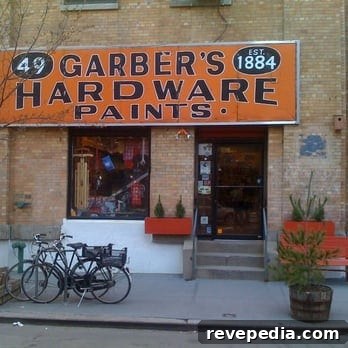
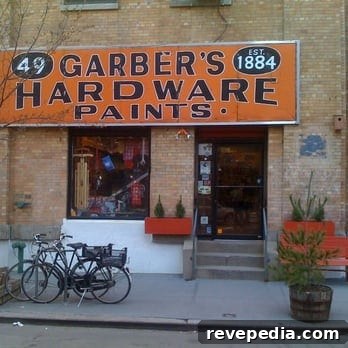
We fondly remember our time living in New York’s West Village—so much so that we named this blog after our cross streets. We miss the charming, tree-lined avenues, the beautifully restored brownstones, and neighborhood institutions like Garber Hardware, which has served Manhattan and the West Village since 1884.
Nathaniel Garber Schoen currently runs Garber Hardware. During our years on Charles Street we had the pleasure of meeting him. Nathaniel helped us with a variety of apartment issues and contributed practical how-to content to this blog, including guides on fixing a running toilet and making a magnetic bulletin board.
Family-owned shops like Garber’s are part of what gives New York City its distinct character. They bring depth and a sense of community to the neighborhoods they serve.
We recently caught up with Nathaniel to learn more about the store, its customers, and his favorite DIY advice.
CH: You’re the fifth generation to run Garber Hardware, and the store’s history is woven into the neighborhood’s fabric. Can you tell us about Garber Hardware’s background and your family?
Nathaniel: The Garber family emigrated from Odessa, Russia, in the late 1800s to escape the pogroms. Garber Hardware began as a pushcart business founded by my great-great-grandfather, Joseph Garber, and his son Nathan Garber (my great-grandfather and namesake). They opened the storefront at Eighth Avenue and Horatio Street in 1884, and a Garber descendant has led the business in each generation since.
CH: With big-box retailers changing how DIY shoppers buy tools and supplies, how has Garber Hardware managed to endure and thrive?
Nathaniel: Being located in Manhattan helps, but more importantly it’s the “Garber experience” that keeps customers loyal. Many people have childhood memories of the store, and some customers follow in the footsteps of parents and grandparents who shopped here. When a Home Depot opened on 23rd Street a few years ago, I didn’t see a negative impact. If anything, it may have driven new customers to our shop.
CH: What advantages do you have over Home Depot and Lowe’s?
Nathaniel: Our strengths are curated selection and personalized customer service. People often assume a 60,000 sq. ft. big-box store must carry far more than our 6,000 sq. ft. shop, but that isn’t always true. We stock many specialized items and can source hard-to-find parts or suggest reasonable substitutes when products are discontinued. Even more important, we help customers one-on-one through their projects. We’ll offer advice—even if it means a customer leaves empty-handed because they don’t actually need to buy something. That honesty builds trust and repeat business.
CH: Do you have plans to expand?
Nathaniel: I’d love to open another location and have researched opportunities, but the high cost of doing business in New York makes expansion difficult. The neighborhoods I’ve considered would benefit from a smaller Garber-style store, yet commercial rents have kept me priced out so far.
CH: What are the most common home-improvement questions you answer?
Nathaniel: Clogged drains and running toilets are frequent issues, along with household electrical questions like installing dimmers and light fixtures. Pest control is another universal concern—mice and roaches show up in New York apartments even for very tidy residents.
CH: What unique challenges do New York apartment dwellers face?
Nathaniel: Storage is a constant problem in the city. Some customers ask about installing dishwashers or washer-dryers in apartments where it’s not straightforward—sometimes it can be done, sometimes not. Building owners also have to navigate Historic Preservation rules and regulations if their properties are designated landmarks.
CH: We’re creating a DIY City Guide for New York. Besides Garber Hardware, are there independent shops or vendors you recommend?
Nathaniel: A few long-standing places come to mind, though several have closed or moved. In Manhattan, Aronson’s Floor Covering remains a great resource (they typically work with interior designers and installers). George Taylor Specialties is another venerable shop I rely on for odd plumbing parts—if they don’t have a part, they can make it in their onsite machine shop. For raw materials and parts I often recommend Standard Tinsmiths and Grand Brass, now located in Long Island City.
CH: When you’re not helping customers at the store, where do you go and how do you relax?
Nathaniel: My art studio is in the back of the store, so I often relax there. I’m a passionate snowboarder and try to take as much winter time off as possible to head to the snow. In February I’m sometimes hard to find at the shop; when a powder day hits, customers know to call ahead. I once closed for a “powder day” and drove to Vermont—my regulars understand and support occasional schedule lapses, though we generally strive to keep posted hours.
CH: Being in Greenwich Village, do you and the store participate in local events or organizations?
Nathaniel: We contribute when we can—donating supplies to parks and nonprofits, collecting food donations at certain times of year, and participating in a battery-recycling program. I’m an animal lover: my dog Kodos is the store’s most popular “employee.” We partner with Animal Haven Soho and act as on-call handypersons for their shelter. We also host puppy adoption events most Sunday afternoons—there’s nothing like a day at work filled with puppies to brighten things up.
CH: Thanks for your time. Can you leave us with your favorite home-improvement tip?
Nathaniel: My advice is simple: just go for it. Don’t be afraid to make a mess or to put a hole in something. Start the project and accept that it will likely throw unexpected challenges at you—roll with them. Most jobs don’t require trade-union membership; they need confidence, the willingness to try, and plenty of patience.
You can usually find Nathaniel at Garber Hardware, located at 710 Greenwich Street, New York, NY 10014. Phone: 212.242.9807.