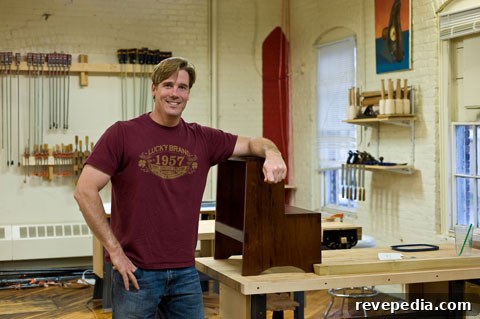
Last month, WGBH announced it would produce a new woodworking series titled Rough Cut with Tommy Mac. We were fortunate to interview Tommy Mac about the upcoming show, his background in woodworking, and his advice for amateur woodworkers.
CH: Congratulations on the new show, Rough Cut, airing on public television. How did the program come about?
Tommy: It started in 2006 when I made a podcast for BobVila.com while building a bombe secretary. Some friends at WGBH noticed my work. After a couple of years they encouraged me to take woodworking to television. Through introductions I met the executive producer of lifestyle programming and the vice president of national programming at WGBH. We discussed the idea, they wanted to develop a show, and I kept pushing because I believed it was the right time. That persistence led to where we are now.
CH: What does Rough Cut offer viewers that they haven’t seen on DIY woodworking shows?
Tommy: Our approach is straightforward and honest. Many modern shows are produced quickly and cheaply, but we focus on teaching techniques, the how-to, and the process. We take time to explain fundamental woodworking skills in depth. A distinctive element of the series is our use of rough-cut lumber—real, unprocessed wood rather than manufactured or pre-cut pieces and plywood. That choice gives the projects a different look and feel.
We also aren’t afraid to show mistakes. Everyone makes them, and we demonstrate how to fix errors and still produce a beautiful finished piece. Showing how to recover from mistakes helps viewers learn and prevents frustration.
CH: What projects will you feature this season? Any surprises?
Tommy: The season includes approachable projects with a bit of flair. I like to interpret classic forms in ways that reveal new possibilities in rough-cut lumber. For example, our Shaker nightstand teaches tapered legs and mortise-and-tenon joints, but made from highly figured curly maple it becomes something unexpected and striking—unlike what you usually see on television.
CH: Public television has a strong tradition of thoughtful how-to programming. How do you envision the show evolving?
Tommy: WGBH has an incredible legacy in how-to television—think Julia Child, This Old House, and The New Yankee Workshop. No one matches their expertise in educational programming. My priority is to stay true to the show’s core values: provide more information about woodworking techniques and less about the personality of the host. If we maintain that focus, I think Rough Cut can earn a place among those distinguished programs. WGBH and I will evolve the show together while keeping those values central.
CH: Have you noticed any new trends in woodworking, either in techniques or products?
Tommy: There are several developments—some positive, some less so. One encouraging trend is that more people are returning to the shop, perhaps due to economic conditions that have renewed interest in hands-on, do-it-yourself activities. Tools and projects that are more manageable help bring newcomers into the craft. I want to highlight smaller woodworkers working in modest shops—those makers are an important part of the resurgence.
CH: Tell us about your woodworking background and where you find inspiration.
Tommy: I began woodworking in sixth grade. I trained at Blue Hills Regional Vocational High School, completed an apprenticeship with the carpenter’s union, and worked as a carpenter for about 15 years. Ten years ago I discovered the North Bennet Street School and was introduced to furniture making, which expanded my understanding of craftsmanship. I draw inspiration from architectural details, museum exhibits, compelling furniture, and the character of rough-cut lumber. I have plenty of ideas; it’s mostly a matter of finding the time to realize them.
CH: As an amateur woodworker, where should I start? Any beginner projects that are challenging but doable?
Tommy: I think beginners will enjoy the projects featured on the show. Two that I began with personally are a Shaker step stool, which focuses on dovetails, and the Shaker nightstand, which teaches mortise-and-tenon joints and tapered legs. These projects introduce core techniques and build foundational skills that are essential for progression.
CH: Beyond watching Rough Cut, what resources should a new woodworker look for to continue learning? Any favorite books or sites?
Tommy: There are countless woodworking resources online and in print. Do some research to find the communities or references that resonate with you. Start with subjects that inspire you and immerse yourself in those areas to develop your own style. I also recommend participating in forums and local groups where you can ask questions and see others’ work. If you haven’t visited my 207 forum online, it’s a great place to connect with other woodworkers.
CH: What three tools could you not live without?
Tommy:
Hand plane
Chisel
Band saw
CH: If you weren’t in the woodshop, where would you be—fishing or catching a game?
Tommy: I rarely leave the shop, but if I did I’d probably be fishing. I’m also a sports fan—Red Sox, Patriots, Celtics, and Bruins.
CH: Share a favorite DIY or woodworking tip.
Tommy: Keep your edges sharp—hand planes and chisels make all the difference. And don’t get discouraged; persistence is part of the craft.
CH: Thanks for your time, Tommy, and best of luck with the new show.
If Tommy Mac has inspired you to try woodworking, there are many helpful books and online resources to learn the basics. One recommended title is Woodworking Basics: Mastering the Essentials of Craftsmanship by Peter Korn, which is based on a fundamentals course at the Center for Furniture Craftsmanship in Camden, Maine. It emphasizes traditional skills and the importance of mastering basic techniques.
Rough Cut with Tommy Mac is scheduled to begin airing in October 2010 on public television.