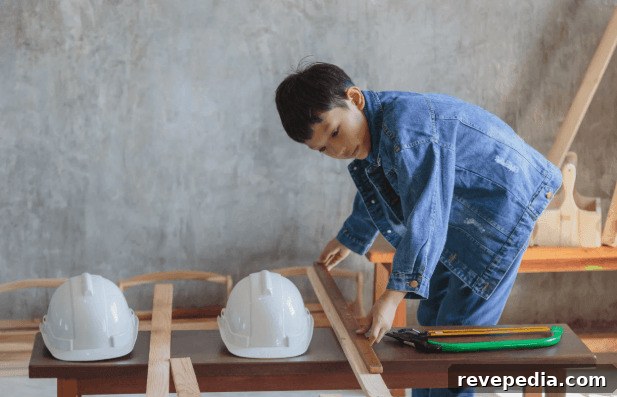
Raising children who can solve problems with their hands is deeply rewarding. Whether they’re building a birdhouse, baking bread, or learning to balance a simple budget, hands-on experiences leave impressions no worksheet can match. For families who want their children to become capable, curious adults, creating a practical, intentional space for learning is one of the best investments you can make.
A family workshop doesn’t require a fully equipped garage or an expensive remodel. At its heart, it’s an environment where kids are invited to try, fail, tinker, and build with the support of caring adults. The simplest setup that encourages experimentation and responsibility is enough to spark lasting growth.
Image by Gianluca Pantaleo on Canva
Start With the Right Mindset
Before buying supplies or rearranging a shelf, establish the attitude your family brings into the space. A healthy workshop culture accepts mistakes, treats messes as manageable, and values effort over flawless outcomes. This mindset encourages persistence and curiosity.
Let an eight-year-old attempt to wire a simple circuit, even if it takes several tries. Allow a teenager to plan a small woodworking project from scratch instead of relying on a kit. The real goal is the thinking and problem-solving that happens along the way, not just the finished product.
When children understand that the workshop is a place for experimentation, they’re more willing to tackle unfamiliar challenges. That confidence transfers beyond the workbench into school, relationships, and future careers.
Designing the Physical Space
You don’t need a huge area. A corner of the garage, a folding table in the basement, or a shelf unit in a spare room can become a functional workshop. What matters most is organization, accessibility, and clear boundaries that make the space their own.
Store tools and materials at heights children can reach. Label bins and drawers so kids can find and return items without help. A pegboard is an inexpensive, practical investment: it keeps tools visible, reduces clutter, and reinforces that part of any craft is caring for your equipment.
For younger children, start with low-risk materials such as cardboard, craft foam, simple hand tools, and non-toxic adhesives. Gradually introduce more advanced materials as skills and responsibility grow. The environment should make clear this is their space for learning and making, not merely a place where adults occasionally let them help.
Connecting Hands-On Work to Real Ideas
A workshop becomes educational when it links physical projects to broader concepts. Building a raised garden bed teaches carpentry skills while reinforcing measurement, planning, biology, and patience. Cooking from scratch demonstrates fractions, chemistry, and sequencing.
Using intentional resources and curricula can help families connect project-based learning to real-world ideas. When children build something and also learn the economic or civic context behind why people trade and create, the workshop becomes a launching pad for genuine critical thinking.
By tying hands-on activities to clear ideas—how things are made, why markets exist, how communities solve problems—families give children both skills and context for why those skills matter.

Projects That Grow With Your Child
A family workshop is inherently scalable. The same space that helps a six-year-old practice safe scissor use can support a sixteen-year-old learning basic electronics or home repair. Plan projects that evolve with children’s skills and interests.
Consider rotating through project categories by age:
- Elementary years: Simple woodworking like birdhouses or picture frames, basic sewing, cooking and baking, gardening, and battery-powered circuit kits.
- Middle school years: More complex builds such as small furniture or garden structures, sewing with patterns, introductory coding and robotics, and supervised basic home repairs.
- High school years: Independent project planning, budgeting for materials, entrepreneurial endeavors like selling crafts or produce, and supervised learning of trades such as basic plumbing or electrical skills.
Older projects that incorporate entrepreneurship and budgeting naturally teach economic thinking alongside practical skills. Teens who plan, price, and sell a product gain insight into supply, demand, costs, and value creation.
Making It a Family Ritual
Workshops succeed when learning together becomes a regular part of family life. Reserve consistent workshop time each week—an hour on Saturday mornings, for example. Rotate who chooses projects and let kids lead sessions where they teach a skill they’ve mastered.
When parents work beside children instead of only supervising, the dynamic shifts. Kids watch adults tackle problems they don’t immediately know how to solve and learn that competence grows through practice, patience, and persistence.
Creating a family workshop is ultimately about shaping a culture where curiosity is practiced and learning extends beyond desks and screens. Tools and projects will change over time, but the habits of thinking and doing developed in that space will last a lifetime. Start small, be consistent, and let the process of making become the primary teacher.