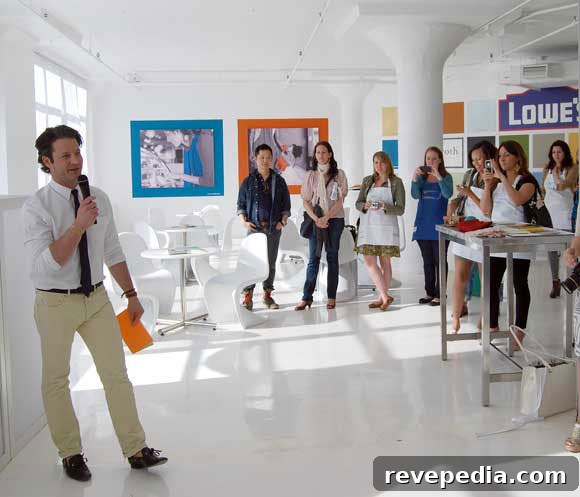
Attending a media event hosted by Nate Berkus and sponsored by Lowe’s and Valspar was one of the highlights of our year. The gathering was intentionally small—only about fifteen attendees—creating an intimate atmosphere where Nate shared stories about his design philosophy and walked us through hands-on paint and styling activities arranged by Lowe’s.
Throughout the afternoon, Nate offered practical tips and subtle insights into what he favors when designing a room. His approach balances thoughtful technique with an openness to experimentation. Below are the key takeaways from our conversation with him.
1. Any color can work
Nate emphasized that virtually every color can succeed in a space, depending on lighting and personal preference. He encouraged exploring the full range of colors available rather than limiting yourself to a familiar subset. Often, a color that seems unlikely in a swatch can come alive once it interacts with your room’s finishes and natural light.
2. Test colors in real lighting
Testing paint under different lighting conditions is essential. What looks right under store lighting or on a small swatch can change dramatically on your walls and in varying light throughout the day. Nate recommended applying multiple test patches and observing them at morning, afternoon, and evening light, and with both ambient and task lighting, before committing to a shade.
3. Gray is a favorite neutral
For a reliable foundation, Nate often turns to gray. He finds gray provides a versatile backdrop that supports richer, bolder accents without competing with them. In many of his schemes he pairs gray with vibrant hues—yellow and black were examples he mentioned—to create contrast and energy while maintaining balance.
4. Green is a go-to accent
Nate spoke frequently about green as a personal favorite. He appreciates green’s associations with balance, harmony, and growth, and uses it to bring a sense of calm and life to interiors. Whether introduced through paint, plants, or textiles, green can connect a room to the natural world and support a restful atmosphere.
5. Travel fuels creativity
One of Nate’s strongest sources of inspiration is travel. He described seeing other cultures’ interiors, patterns, and ways of living as a powerful way to broaden one’s design vocabulary. Experiencing different homes, materials, and color combinations around the country and the world enriches how he imagines and composes spaces.
These tips capture Nate Berkus’s thoughtful, exploratory approach to design: be willing to experiment, test carefully, and draw inspiration from diverse experiences. If you follow these principles—open-minded color choices, real-light testing, neutral foundations like gray, accents of green, and inspiration from travel—you can create layered, personal interiors that feel both intentional and lived-in.
Did you find Nate’s tips useful? Are you sorry to see his TV show end?