When we bought our house last year, we inherited a dying peach tree and another dead tree that we couldn’t identify. They sat in our yard for a year, so this winter we decided to cut them down and turn the wood into firewood for our den and for future camping trips.
To keep the wood organized and accessible, we also needed a simple firewood rack.
Before starting, we gathered tools and personal protective equipment.
STIHL MSA 200 C-BQ Chainsaw
We used our STIHL MSA 200 C-BQ cordless chainsaw to fell the trees. For splitting and breaking down branches we also used a STIHL hatchet.
We’ve had this chainsaw for a couple of years and relied on it heavily when we first moved in to clear the property.
Even if you’ve used gas or cordless saws before, read the manual for the STIHL MSA 200 C-BQ before use. Controls and features can vary between models.
The previous owner left a large pile of yard debris from trees that were cut down but never removed. We needed to clear that as well.
Each time we use the chainsaw we perform a quick pre-check:
- Top off the bar oil.
- Check chain tension: grasp the chain from the bottom and ensure it snaps back into position. Tighten if needed.
- Use a fully charged battery.
- Visually inspect the saw, test the brake, and listen for any unusual sounds.
Personal Protective Equipment (PPE)
Safety gear is essential when using a chainsaw. PPE is affordable and widely available at local stores or online. We always use:
- Chainsaw leg protection that fits over pants and covers the top of your boots.
- Safety glasses.
- Head protection with a face screen.
- Hearing protection.
- Mid- to high-cut work boots.
- Work gloves.
Felling and Removing the Dead Trees
Before cutting a tree, assess the surrounding area and make sure it is clear where the tree will fall. Check not only the intended fall direction but all directions in case of miscalculation.
The smaller dead tree was in an open area, while the larger one stood next to a chain-link fence. Luckily, there was open space for it to fall and no overhead wires or nearby buildings.
After felling the trees, we limbed them with the chainsaw and used the hatchet to reduce smaller pieces.
Cutting Firewood
The chainsaw handled cutting the trunk into manageable lengths; the hatchet made quick work of larger branches for kindling. We separated the wood into a kindling pile and a firewood pile, so nothing went to waste.
When cutting limbs near the ground, be careful to avoid letting the chain touch the soil, and position your feet well clear of the cutting zone.
Building the Firewood Rack
There are many firewood rack designs, but the best we found is also the simplest.
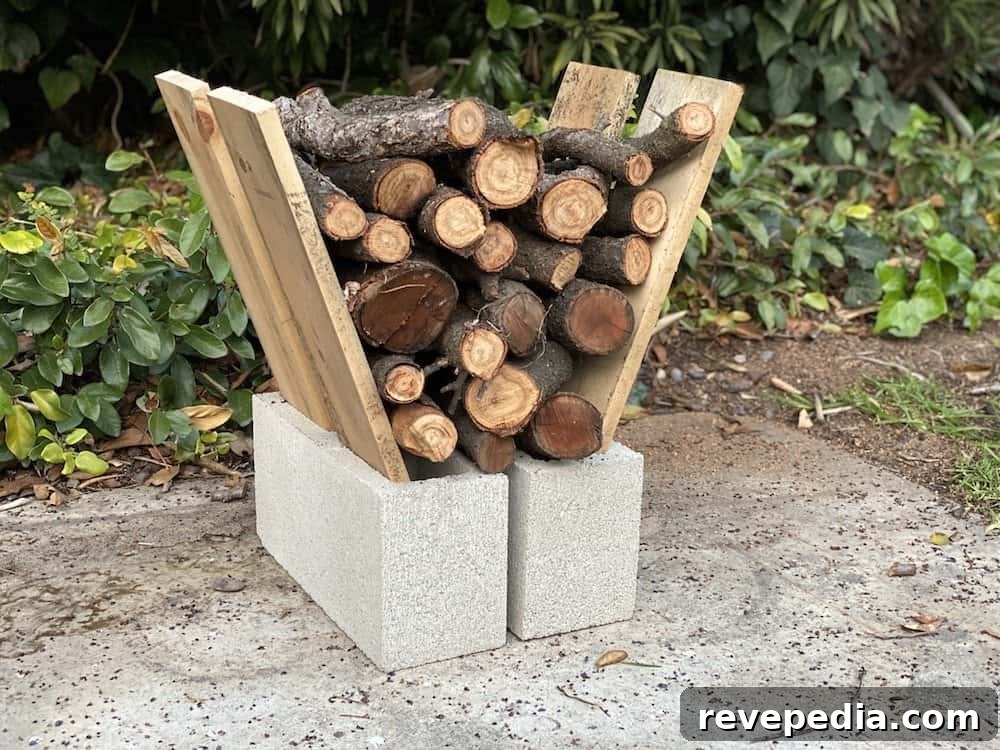
For our rack we used four 5-foot lengths of 2×4 and two cinder blocks.
Place each 2×4 into the open ends of the cinder blocks so the boards face away from each other. This forms two V-shaped supports that hold the wood in place.
That’s it — a quick, sturdy rack that keeps the wood off the ground and organized.
The rack breaks down easily for summer storage or for moving your pile. It’s inexpensive, and you can paint the cinder blocks or 2x4s to suit your style.
If you discover a dead tree in your yard, consider felling it safely and repurposing the wood for camping trips or as supplemental heat. With basic precautions, a good saw, and a simple rack, you can turn unwanted trees into useful fuel.
This post is sponsored by STIHL. The opinions and content are those of Timothy Dahl of Charles & Hudson.