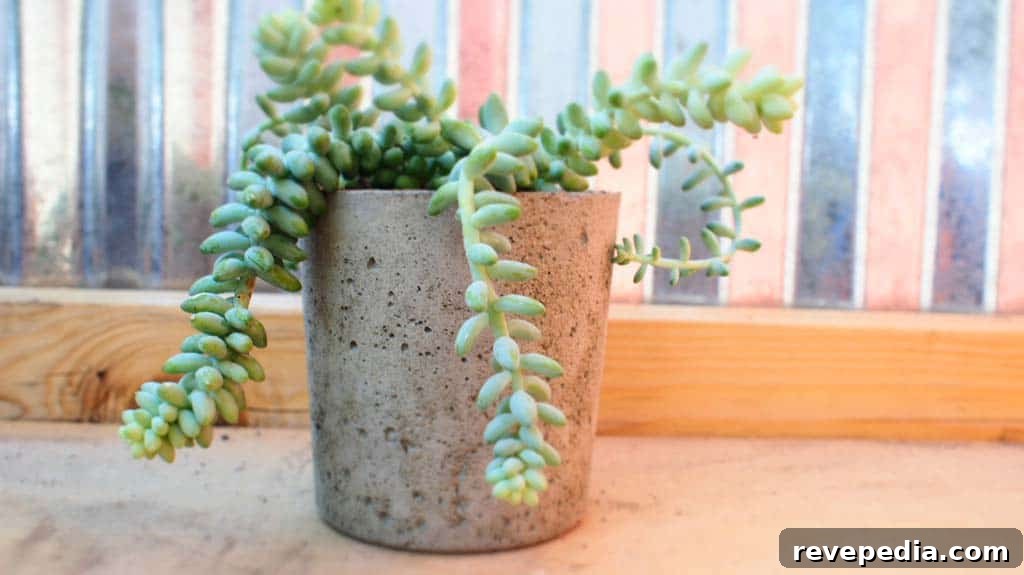
Succulents thrive year-round in Southern California and the Southwest, and they can also do well indoors across the country with minimal care. They need only occasional watering and good drainage. For those who prefer low-maintenance plants, succulents are ideal. While traditional terra cotta pots and brick planters are common, a modern look can be achieved with simple, lightweight cement planters made at home.
Large commercial cement planters are often heavy and oversized for small plants. Because succulents require little soil, we chose to make compact planters using a half-gallon milk carton as the outer mold and a takeaway container as the inner form. This DIY approach produces stylish, contemporary planters that are easy to handle.
This project is straightforward and family-friendly — our four-year-old even helped. You’ll need four containers (an outer mold and an inner mold for each planter), a small quantity of ready-to-use concrete mix, a bucket, a mixing stick, a trowel, and cooking spray. We used a brand of ready-to-use concrete mix for convenience.
Begin by cleaning your molds thoroughly and allow them to dry completely. For the milk carton mold, we cut off the top and used the bottom half. Clean, dry molds help the concrete release cleanly after curing.
Open a bag of ready-to-use concrete mix and measure out about half of the bag (roughly 20 lb if using a 40 lb bag). Pour the measured mix into a bucket and add about 1 1/2 pints of water, then mix thoroughly. The correct consistency resembles thick oatmeal; if the mixture seems too stiff, add an additional 1/2 pint of water and mix again.
Spray the inside of the outer mold with cooking spray to help release the cured concrete. Pour the concrete mix into the mold, but don’t fill it completely—you need space for the inner mold. Insert the inner container into the wet concrete, pressing down so the concrete fills the space between the molds. Place rocks or another heavy object inside the inner mold to keep it from floating upward while the concrete sets.
Allow the concrete to set in the molds for at least 24 hours. After this initial set time, remove the planters from their molds. Plastic molds should release easily; if a planter sticks, a firm tap will usually loosen it. If you used a cardboard mold, you can tear the carton away from the cured concrete.
Proper curing is essential for durable planters. After demolding, prevent rapid moisture loss by either sealing the surface with an acrylic sealer or wrapping the planters in damp burlap for a few days. Full curing typically takes five to seven days. Once cured, add potting soil and your succulents.
For watering, use a spray bottle and mist the succulents about once a week. This method keeps both soil and plants lightly moist without risking standing water, which succulents dislike.
These compact cement planters make attractive centerpieces for patio tables and work well indoors on windowsills and shelves. For a personalized touch, you can paint them or leave them raw for a minimalist, modern aesthetic.