
Transforming a basic backyard into a space where children truly want to spend time doesn’t require a complete redesign or a huge budget. It does require thoughtful planning of the layout, surfaces, boundaries, and equipment so the yard works safely and enjoyably for different ages and types of play. When you get the fundamentals right, the rest naturally follows.
Start with the layout before anything else
Before buying equipment or toys, take time to consider how the yard is currently arranged and where new elements could fit. The most functional outdoor spaces have clearly defined zones instead of trying to be everything to everyone in one undifferentiated area.
Create distinct areas for active play, a softer zone suited to younger children, and a comfortable spot for adults to sit and supervise without hovering. Prioritize sightlines from the house: being able to see the play area from a kitchen window or back door makes parents feel more at ease letting kids play independently.
Get the surface right before installing anything
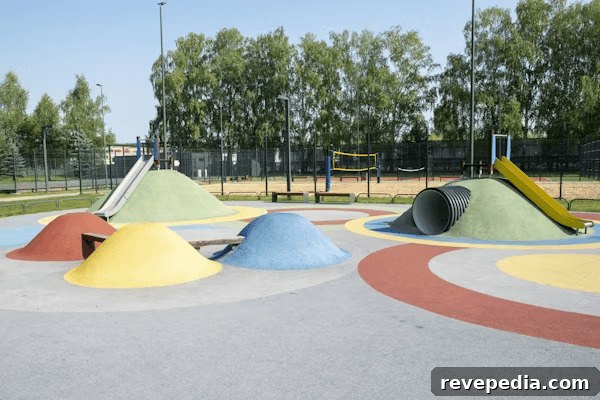
Surface choice is one of the most important—and most often overlooked—aspects of a safe play area. While grass is okay for low-impact activity, it wears away quickly under equipment, becomes slippery when wet, and offers limited impact absorption for falls from height.
Rubber tiles or wet-pour rubber surfacing are better options beneath swings, climbing frames, and monkey bars because they cushion falls more effectively than bare soil or compacted turf. Match the surface to the critical fall height of the equipment you install: sorting this out ahead of time prevents expensive and unsafe retrofits later.
Include a flat, hard surface—pavers, concrete, or compacted gravel—somewhere in the yard. Smooth areas let kids ride bikes, scooters, and skates properly and help keep those activities separate from softer play zones used by toddlers.
Fencing and boundaries matter more than you realize
A securely enclosed yard is essential for independent outdoor play. Children can’t be safely left to play freely if the boundary is uncertain. Inspect fences for gaps, unstable sections, and gates that latch properly yet are easy for adults to operate.
If a pool or water feature exists on the property, fencing is non-negotiable and often required by law in many parts of the United States. Even without water hazards, a properly enclosed yard lets parents step back and trust that kids are safe—making regular outdoor time far more sustainable for families.
Choosing equipment that’s genuinely safe and worth having
With the space and surfaces sorted, selecting equipment becomes clearer. Prioritize durable items that meet safety standards rather than cheaper options that degrade quickly or fail under normal use.
Look for powder-coated steel and treated timber, and choose UV-resistant plastics to avoid rapid cracking and fading. Quality materials extend the lifespan of play equipment and reduce maintenance needs.
Trampolines are one of the most frequently used backyard additions and can support balance, coordination, and core strength while offering sensory regulation benefits. When choosing a trampoline, pick models with built-in safety features and construction designed to last.
Swing sets, climbing frames, and monkey bars provide varied movement opportunities and help children develop strength and coordination. Inflatable options—bounce houses, inflatable obstacle courses, and water slides—can add hours of entertainment for gatherings or special occasions, but choose robust, well-made versions suitable for repeated use.
The smartest approach is to select modular systems and adaptable products that grow with children. Avoid fixed installations that become obsolete in a few years. Start with a solid, well-planned base and add features over time as needs and interests evolve.
Where to get your hands on a trampoline
Trampolines are widely available, but quality varies. Treat a trampoline purchase as an investment: choose models that offer durable construction and safety engineering to keep children using them for many years. Select the appropriate size for your yard and the ages of your kids to maximize longevity and enjoyment.
Final thoughts
Preparing a yard for safe outdoor play is mainly about getting the fundamentals right: appropriate surfaces, secure boundaries, well-chosen equipment, and enough shade to keep the area comfortable year-round. When those basics are in place, a backyard becomes a reliable, everyday play space that can be enhanced gradually over time.