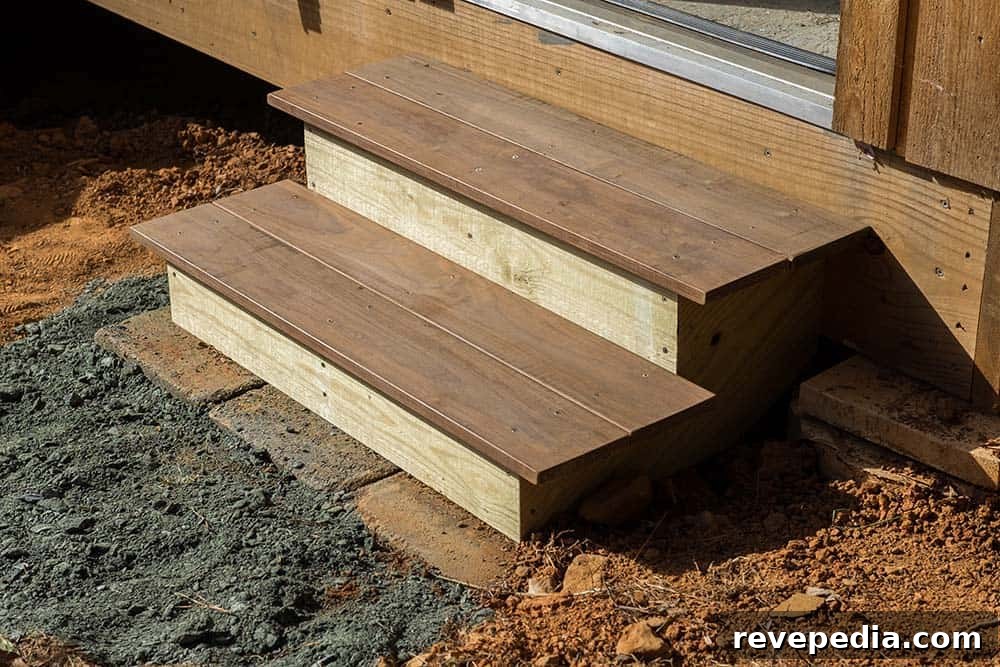
Ipe (pronounced ee-pay) is an exotic hardwood that has gained popularity for decking and outdoor stair projects because of its exceptional durability and natural resistance to decay and rot. It’s significantly harder than many common decking woods and can provide decades of service without the chemical preservatives used in pressure-treated lumber. These qualities make ipe an excellent choice for the visible parts of steps, while more economical, treated lumber can be used for the structural framing beneath.
Tony Stillwell and his son Mike recently built steps for a barn in North Carolina and documented the process. They shared the layout, measurements and construction approach used to fit steps to a 36″ doorway. The project demonstrates not only good materials selection but also careful planning for rise, run and structural support. Mike photographed the build at each stage to illustrate the technique.
Before installing the stairs, create a stable foundation with bricks or pavers set slightly below grade and leveled. In regions with freezing temperatures, set footings below the local frost line to prevent movement during freeze-thaw cycles.
The steps were designed and built with safety, comfort and longevity in mind. Here is the approach Tony used and why each choice matters.
Designing comfortable stairs requires attention to slope and consistent step dimensions. A comfortable walking slope for stairs is often around 32 degrees, but variations near that value are acceptable depending on space and function. Consistent riser height and tread depth are crucial: uneven steps increase the risk of trips. The builder also needs to ensure the structure is strong enough for years of use.
For this project the overall slope measured about 29 degrees, slightly shallower than the theoretical optimum but still comfortable. Each tread is 11″ deep, and each riser measures 5 9/16″ from top of one tread to the top of the next. The treads are made by pairing 5½” wide ipe decking boards to achieve the desired tread depth and an attractive, durable walking surface.
In the layout, Tony included the threshold as the top step, which in this case makes three steps total. That means only two cut stringers are required to support the visible steps below the threshold.
To find individual riser height, divide the total rise—16 3/4″ for this installation—by the number of steps (3). That gives a riser of 5 9/16″ including the thickness of the ipe boards. Using consistent math up front keeps every step uniform and safe to use.
Tony cut three stringers from 2″x12″ pressure-treated boards, making sure the grain runs diagonally across the board for best strength. Accurate, square cuts are essential so the assembly sits level and supports the decking properly. A table saw produces the most precise cuts; a quality jigsaw or a sharp handsaw can work if you cut carefully and clean up with a chisel where necessary. When cuts are accurate, sanding shouldn’t be required.
When spacing stringers, provide adequate support for the decking—16″ on center is a common standard and a good target for long-lasting stiffness. More stringers or closer spacing will increase rigidity and reduce deflection.
Because the steps needed to align with a 36″ door, Tony used 36″ long ipe decking boards to form the treads. He constructed a box-like structural frame from the stringers and 2″x6″ pressure-treated risers, fastening the assembly with stainless steel screws and construction adhesive where appropriate. The frame was attached to the building skirt using angle brackets and galvanized nails for a secure connection.
The ipe decking treads were fastened to the structure with stainless steel screws. Coated decking screws are an acceptable alternative, but stainless steel fasteners prevent corrosion and match the long lifespan of the wood. Tony chose to overbuild the fasteners for added security.