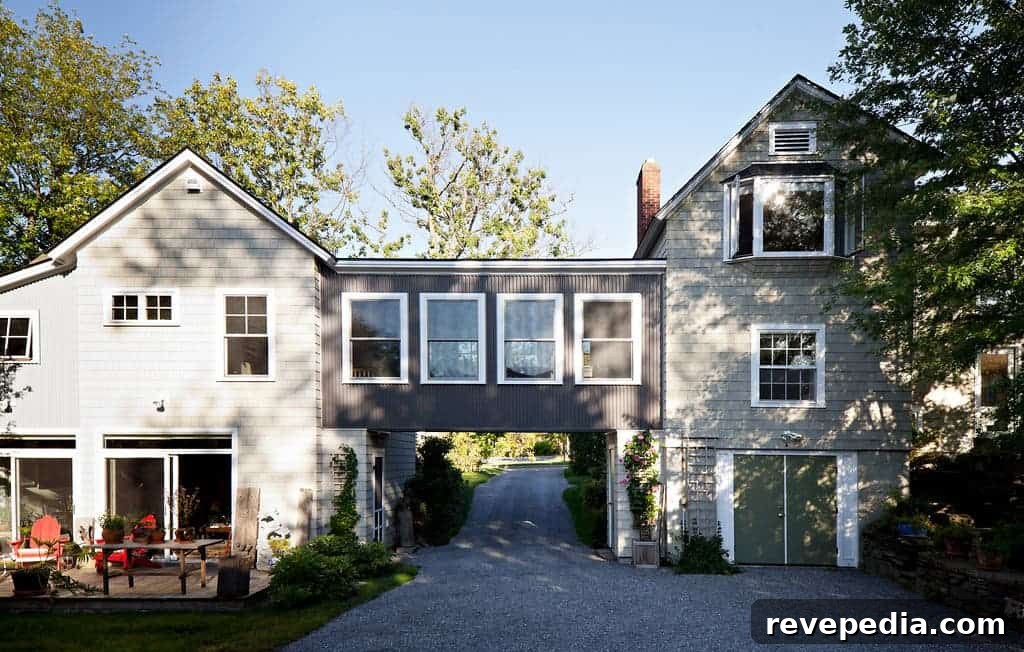
The concept of building a bridge between two homes is gaining renewed interest. Once a common architectural feature in many cities, these sky bridges are now reappearing in residential projects as homeowners look for creative ways to connect separate living spaces while preserving privacy and functionality.
People often value private, well-defined spaces: a cozy reading nook, a spa-like bathroom, or a bright home office designed for focus. A bridge between homes allows each occupant to retain distinct personal areas while providing a sheltered, direct link for shared use.
Sky Bridge / Skywalk
Skywalks are most visible in dense urban areas such as New York City, where tall buildings are separated by narrow streets. These elevated passages historically allowed people to cross busy thoroughfares safely and efficiently, and they remain an evocative element of older cityscapes.
Although contemporary architecture rarely includes new skywalks in commercial towers, the examples that remain convey a certain nostalgia and practicality. In residential contexts, the same idea can be adapted to connect separate structures on a property, especially where ground-level connections are impractical.
Bridge Between Two Homes
Connecting two homes via a sky bridge may seem novel—after all, many people would simply walk outdoors or build a ground-level connector. However, when zoning, terrain, or property layout prevents an at-grade connection, a sky bridge becomes an appealing and sometimes necessary solution.
Cost and engineering complexity can make sky bridges more expensive than traditional additions. Yet when lateral separation is the only option, a bridge can provide a sheltered, direct route that enhances both convenience and safety.
Guest Houses and “Mother-In-Law” Suites
Guest houses—often called mother-in-law suites—are a popular way to keep family members nearby while granting everyone privacy. A detached guest house provides independence but can create challenges if quick access is needed for care or emergencies.
A sky bridge solves that issue by effectively becoming a covered hallway between two separate dwellings. The engineering involved can be impressive and sometimes costly, which is why many homeowners opt for simpler solutions. For others, however, a sky bridge is the best or only viable option to maintain both privacy and accessibility.
Architectural solutions that incorporate bridges can create flexible living arrangements. For example, the artists Eleanor Lanahan and John Douglas designed an addition to Eleanor’s home in Burlington, Vermont, then linked the two structures with a 20-foot bridge. That connection not only provided access between the buildings but also became a shared living space.
In their case, the bridge contains an open kitchen and dining area used by both occupants. Although the couple maintains separate bedrooms and spends much of their time in independent spaces, the bridged areas create meaningful shared zones for meals and company.
If your property, budget, and living needs align, adding an extension and connecting bridge can be an inspired architectural choice. It allows each person to personalize private rooms while preserving communal areas that foster connection.
Bridged homes offer a thoughtful balance between solitude and togetherness. For families caring for aging relatives, partners who value both independence and intimacy, or homeowners seeking unique design solutions, a sky bridge can turn two separate structures into a cohesive, functional home.
Would a bridged home suit your lifestyle—too isolated, or the right kind of privacy to make shared moments more meaningful?