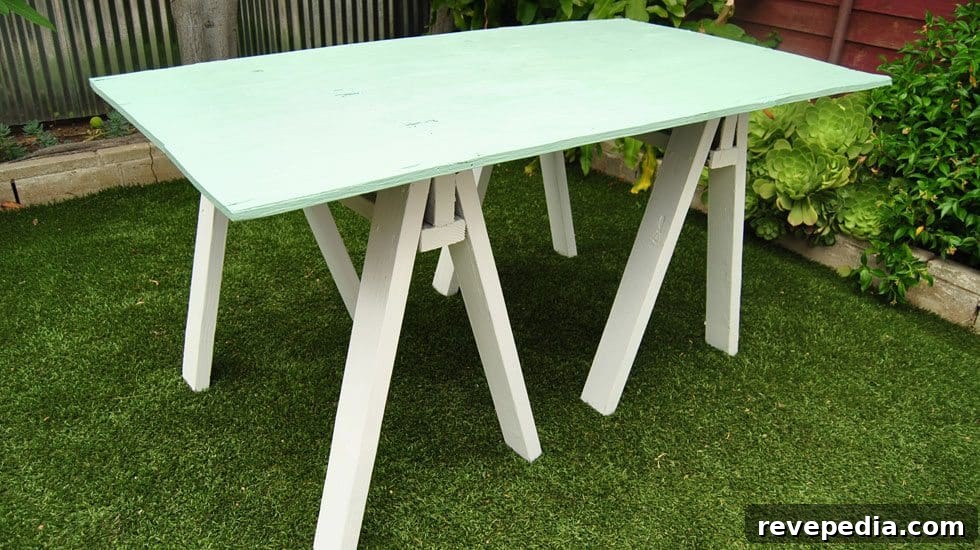
We needed a sturdy outdoor table for a party, and because we already love our sawhorses, we built two and topped them with a sheet of plywood and a fresh coat of paint. The result: a simple, durable sawhorse table that’s quick to assemble and looks great outdoors.
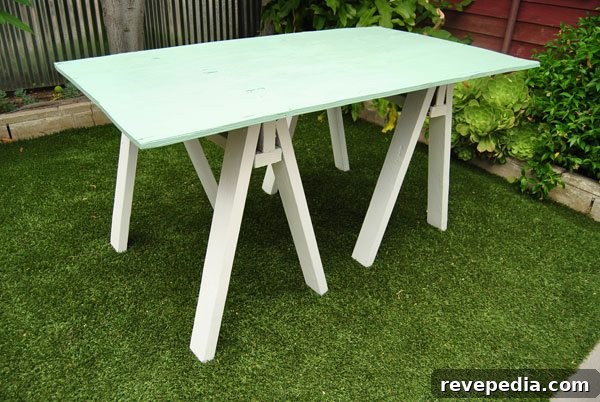
Estimated Project Time: 2 Hours
Difficulty: Medium
Tools & Materials
– 8 pieces of 2×4 cut to 30″ (legs)
– 6 pieces of 2×4 cut to 32.5″ (I-beam parts)
– One sheet of 3/4″ plywood (or 7/8″ if you prefer extra rigidity)
– Box of 2″ wood screws
– Sandpaper: 180 and 220 grits
– Drill/driver with Phillips bit (or a screwdriver)
– Circular saw or handsaw/hacksaw
– Measuring tape and pencil
– Paint and a brush or roller
– Tack cloth for dust removal
This project uses two identical sawhorses that support a plywood tabletop. The design is straightforward and adaptable: you can change the table height or tabletop size by altering lumber lengths or using a different plywood sheet.
Step-by-step Instructions
1. Measure and mark your lumber. Cut eight 30″ pieces for the legs and six 32.5″ pieces for the central I-beam portions.
2. Work in a well-ventilated area and secure each 2×4 in a vise or clamp to keep it steady while cutting.
3. Cut all pieces to length with a circular saw or a suitable handsaw. Take care to make straight cuts for stable assembly.
4. Smooth all surfaces and edges with 180-grit sandpaper, then finish with 220-grit for a pleasant, splinter-free touch. Sand the tops, sides, and leg ends.
5. Remove dust with a tack cloth so paint will adhere cleanly.
6. Paint the individual pieces. Applying paint before assembly makes coverage easier. Allow paint to dry for 2–4 hours or according to the paint manufacturer’s instructions.
7. Assemble the I-beam for each sawhorse. Lay three 32.5″ pieces out in a “T” configuration: one central vertical member with two cross pieces forming the top flange. Fasten them together with 2″ wood screws, using enough screws to create a rigid joint.
8. Complete the I-beam by securing the bottom piece to the “T” assembly, reinforcing the structure so it resists racking and holds the legs securely.
9. Position each 30″ leg so its top end sits just under the I-beam top flange. Attach each leg with four wood screws arranged in a rectangular pattern to distribute load and prevent loosening.
10. Repeat for all four legs. Once attached, turn the sawhorse upright and set it on its legs. Confirm that each one stands level and that the legs are tight and secure.
11. Place your plywood tabletop across the two sawhorses. Align it so the edges are even and mark where the sawhorse tops meet the underside of the plywood.
12. Fasten the plywood to the sawhorses with wood screws driven through the tabletop into the top flange of each sawhorse where you marked. Space screws evenly to hold the tabletop flat and stable.
13. Double-check the balance and stability of the completed table. Make any minor adjustments to leg angles or screw tightness to eliminate wobble.
14. Your sawhorse table is ready. Use it for outdoor parties, workbenches, craft tables, or temporary dining. The design is robust, portable, and easy to disassemble or modify.
Tips and variations:
– If you plan to leave the table outdoors, use exterior-grade paint or a weather-resistant finish and consider sealing screw heads with a bit of exterior caulk or wood filler before painting.
– For increased rigidity, use an additional cross brace between each pair of legs.
– Adjust leg length to create a bar-height table or a lower coffee-table height depending on your needs.
Enjoy your new, homemade sawhorse table—built quickly, painted to match your style, and ready for many gatherings to come.