Since moving to Los Angeles from New York City last year, I expected I’d be surfing much more often. That hasn’t quite happened. As soon as the water warmed up, the waves flattened out — the usual Southern California rhythm, I suppose.
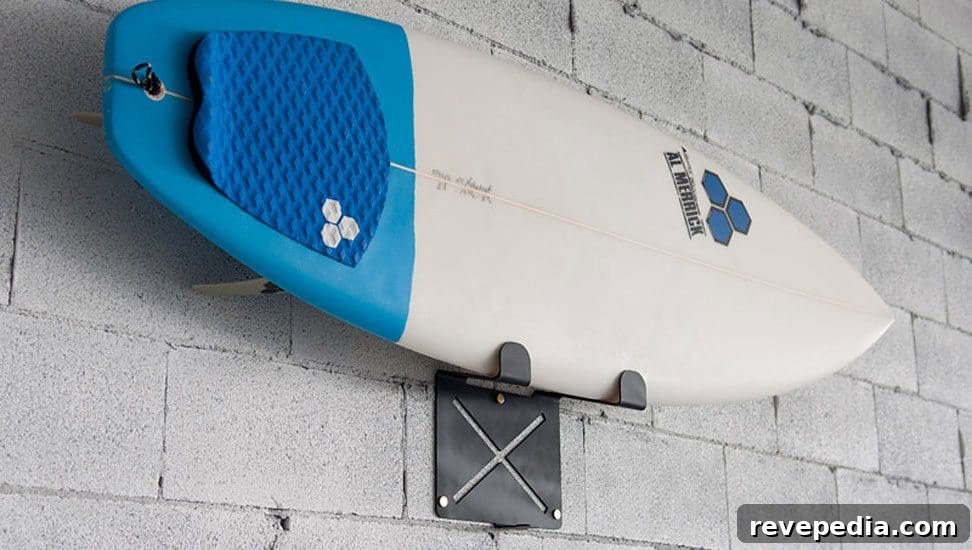
Even though I don’t get to the beach as much as I’d like, I enjoy living vicariously through others, and my favorite surfing blog was El Porto Fridays. The site recently went offline, but I managed to save this excellent photo of the DIY board rack they built in their garage.
This rack is one of the simplest and most effective ways to store a quiver, especially if you own more than three boards. The build is inexpensive and requires only a few basic materials: a 2×4, wood dowels, wood screws and some padding. The builder also installed eyelets at the dowel ends so a cord can be threaded through, preventing boards from sliding out.
At the moment my own boards live outside in board bags, which isn’t ideal, and they sit on their sides on a pallet. I also have an 11-foot Laird Surftech stand-up paddleboard that’s awkward to store upright, so a rack like this would make organizing and protecting my quiver much easier.
Building a similar rack is straightforward: cut a 2×4 to the desired length, drill evenly spaced holes for the dowels, insert padded dowels at a slight upward angle to cradle each board, and secure everything with wood screws. Adding eyelets and a retaining cord is an inexpensive safety measure that keeps boards in place during storms or when stored in a tight garage.
This type of wall-mounted rack saves floor space, keeps boards off the ground where they can collect moisture or get dinged, and lets you store multiple boards neatly side by side. For those with a variety of board shapes and sizes, spacing the dowels slightly wider for larger boards and closer together for smaller ones helps maximize capacity while maintaining stability.
If you plan to build one, consider using weather-resistant materials or finishing the wood with a sealant if the rack will be exposed to humidity or outdoor conditions. Soft padding on the dowels—such as foam pipe insulation or pieces of neoprene—protects the boards’ rails and finishes. Also, mount the rack into studs or use strong anchors to ensure it can bear the combined weight of several boards without pulling out from the wall.
A simple, well-built rack like the one from El Porto Fridays is a practical upgrade for any surfer’s garage. It keeps boards organized, protects them from damage, and makes it easier to access the board you want for any given session. Once I find the right spot in my garage, building one of these racks will be at the top of my to-do list.