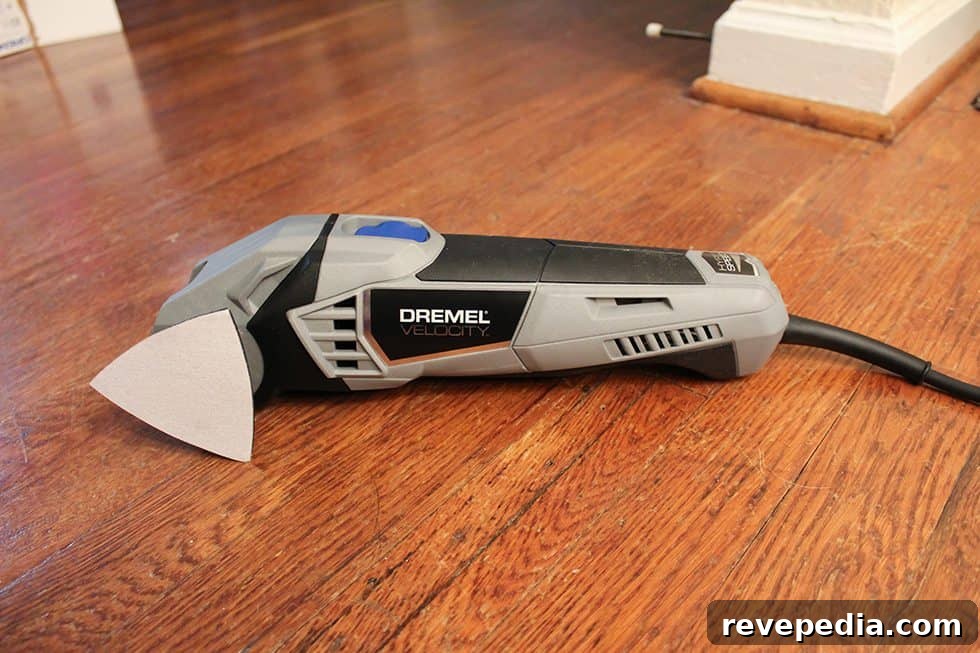
The team at Dremel sent their latest tool, the Velocity VC60, for me to test. Having recently moved into an older house, I was eager to see what this compact but powerful combination tool could do.
From Dremel’s website
The Dremel Velocity VC60 bridges the gap between traditional oscillating tools and aggressive cutting tools like reciprocating and circular saws. The Velocity lets you handle larger jobs that many oscillating tools struggle with. With a strong 7.0 AMP motor, an integrated control foot, a 5-degree oscillation angle, and a newly designed patented drive system, users can make long, accurate cuts quickly in a range of materials. The Velocity has two operating modes: with the control foot open, it excels at long, precise cuts in panel materials; with the control foot closed, it acts as a high-powered oscillating tool ideal for cutting, scraping, sanding, grinding, or grout removal. It’s an excellent choice for professional remodelers who need a fast-cutting, low-dust tool for indoor projects such as bathroom or kitchen remodels, and for homeowners who want one versatile tool instead of buying several to cut plywood, drywall, conduit, PVC pipe, 2x4s, and tile backer during repairs.
I plan to test the Velocity thoroughly, but my first task was straightforward: repairing a rough plaster corner in my living room. Previous owners had installed a shelf and repeatedly painted and replastered around it without removing the shelf, leaving a mess of uneven texture and holes.
After removing the shelf with minimal additional damage and filling the holes and divots with spackle, I brought out the Velocity.
With a 7.0 AMP motor, this isn’t a lightweight hand tool. The tool weighs roughly 4.5 lb, which was evident when I unboxed and set it up for sanding. But once it was running and I made contact with the wall, the oscillating action made it easy to control. The motor is relatively quiet—likely quieter than most hair dryers—though still noticeable in a quiet room. My kids, who were watching TV nearby, were more upset that I had to move the television to reach the awkward spot than bothered by the sound or dust from sanding.
Within minutes the rough edges of my spackling were smooth and even, and the harder outline of paint and plaster left around the old shelf blended seamlessly into the existing wall texture.
What impressed me most was how well it preserved the existing plaster texture. The Velocity’s speed and pressure were enough to get the job done quickly without the collateral damage that larger sanding tools can cause. One quick pass with the vacuum and it looked like I hadn’t sanded a sizable portion of the living room. I was so pleased with how easy it was to use that I filled and sanded additional spots around the room. What used to be a laborious job that would have taken hours by hand was completed in about thirty minutes, saving time and effort.
The Velocity kit includes accessories for sanding different surfaces and grits, plus three cutting blades:
- VC490 Panel Blade
- VC494 Pipe and 2×4 Blade
- MM450 Wood and Drywall Blade
- MM70W Sanding sheets (3)
- MM70P Sanding sheets (3)
- Storage Bag
The wood and drywall blade will likely be the next accessory I test. The included storage bag makes it convenient to keep the tool and attachments together for quick, often messy, projects.
The Dremel Velocity VC60 is a strong candidate for DIYers with moderate to advanced experience. It combines the capabilities of several tools into one unit, delivering the precision and ease of use Dremel is known for. It’s especially useful for remodelers and homeowners who want a versatile, time-saving tool for a variety of indoor jobs.
Keep an eye out for part two of this review coming in the next few weeks.