Cordless drills are so common today that it’s easy to forget they weren’t always available. Not long ago, most drills were corded, powered only by A/C electricity. Modern professional-grade cordless drill/drivers match the power of corded tools while delivering long runtimes. Advances in battery chemistry, power electronics, and motor control have steadily increased performance, and the mechanics of how drills operate have evolved significantly.
We spoke with Bill Gallagher, Director of Engineering for Drilling and Vertical Fastening at Stanley Black & Decker, to clarify how a drill works. With his experience driving cordless tool innovation—particularly through technologies like DeWalt’s FLEXVOLT platform and the development of cordless table and miter saws—he offers insight into modern drill design and function.
At a basic level, a drill converts electrical energy into rotational torque so you can drill holes, tap threads, and tighten or loosen fasteners. In cordless models powered by lithium-ion batteries, that process also includes an intelligent management layer that protects the battery and optimizes performance.
A lithium-ion battery generates voltage through chemical reactions between its positive and negative electrodes. Packs combine multiple cells in series and parallel to raise voltage and current to levels the motor needs for high torque and speed. Because these cells must operate safely and reliably, cordless drills incorporate sophisticated electronics that monitor the battery before and during use. The tool’s circuitry checks overall pack voltage, voltage differences between cells, temperature, and current draw. Monitoring these parameters prevents damage to individual cells, preserves battery life, and keeps the tool operating safely.
When the user squeezes the trigger, the drill’s control electronics translate that input into electrical power for the motor. Pressing the trigger further tells the controller to supply more voltage or to change the pulse width modulation (PWM) to increase motor speed. In other words, the trigger controls how much electrical energy reaches the motor, which in turn controls rotational speed and torque.
That rotational energy is delivered into a transmission, typically a planetary gearset, which provides selectable gear ratios—usually two or three speeds. These gear ratios let the operator choose the right balance of torque and speed for the job. High-torque, low-speed settings suit large self-feeding bits or hole saws in wood, while low-torque, high-speed settings are better for small twist bits in metal or lighter drilling tasks.
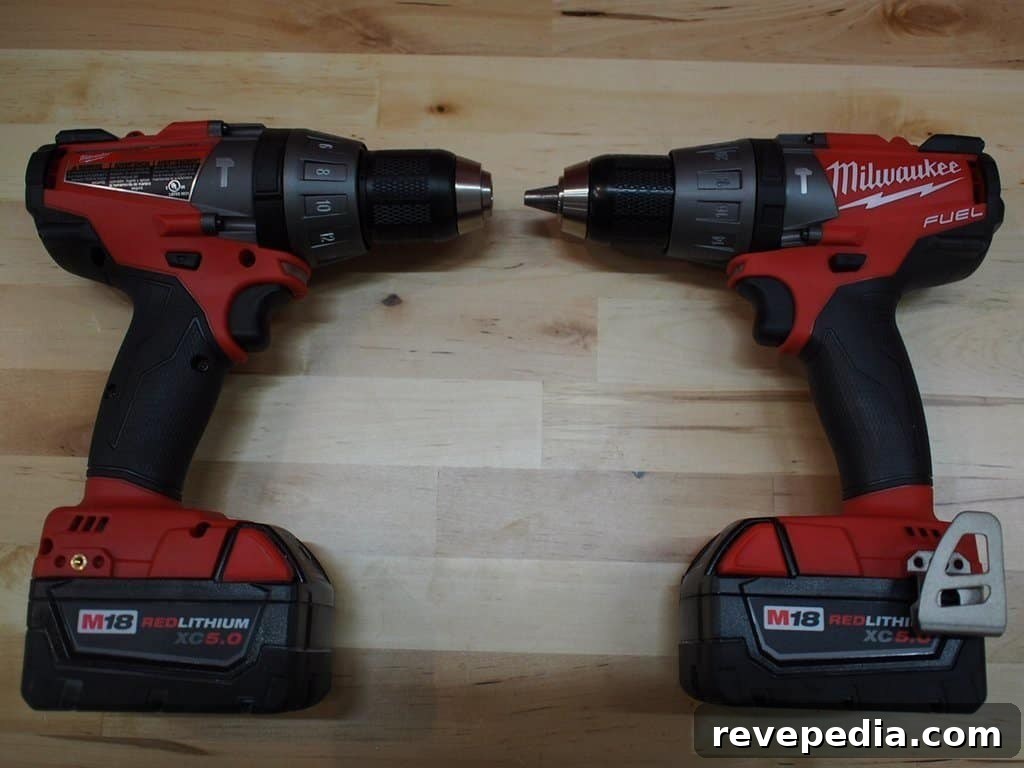
From the gearbox, power flows through the chuck—the clamping mechanism that holds the drill bit or driver accessory. Most chucks use three jaws that close inward to grip a round or hex shank. These jaws apply significant clamping force to prevent slippage under load. Chucks are either keyless, tightened by hand rotating an outer sleeve, or keyed, tightened using a small gear-like wrench that turns the sleeve. Internally, the outer sleeve’s rotation engages threads that move the jaws forward and inward on a slight angle, acting like a wedge to clamp the accessory securely.
With a bit or driver installed and the chuck tightened, the drill is ready to perform. The integrated electronics, battery management, variable speed control, gearbox selection, and robust chuck design together let modern cordless drills deliver the power, control, and safety needed for professional and DIY applications alike.