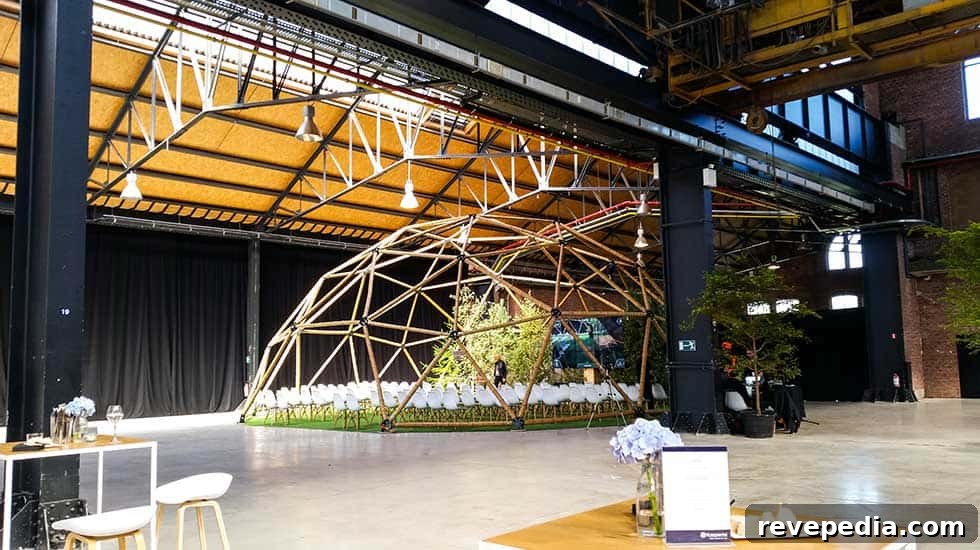
Last week I had the pleasure of joining an international group of industry professionals and Husqvarna at the Silent City press event in Antwerp, Belgium. There, Husqvarna introduced several new lawn-care and forestry products—both practical models and concept designs—showcasing the latest in battery and automation technology.
Husqvarna’s long history stretches back more than 325 years, beginning as a manufacturer for the Swedish monarchy and evolving into a global leader in outdoor power equipment. Today the company delivers tools for forestry, parks, and gardens that balance high performance with usability, safety, and efficiency. Their range includes chainsaws, power cutters, robotic lawn mowers, and a wide selection of accessories—far beyond the sewing-machine brand many of us remember.
Photo: Instagram so_tabulous
The event took place in a former train station converted into a presentation space next to one of Antwerp’s urban parks. It was the perfect setting for the Silent City concept, which explores how green spaces and urban life can coexist harmoniously. Husqvarna’s senior staff presented the environmental, psychological, and social benefits of shared landscaped areas and emphasized the need for state-of-the-art lawn-care equipment not only for homeowners but for municipal and fleet teams. These teams must maintain communal grounds to high standards while working efficiently and quietly to minimize disruption for nearby residents.
To demonstrate the difference in real terms, a Husqvarna technician climbed a tree in the center of the venue and used a high-powered battery-operated chainsaw. The contrast with traditional gas-powered tools was striking: attendees noticed a dramatic decrease in noise and were impressed by how quickly the branch was cut through despite the reduced sound signature.
Credit: David St. Martin/www.workingforest.com
Husqvarna’s commitment to innovation is clear: their philosophy that “every product is a service waiting to happen” has guided the company through social, environmental, and technological shifts while competitors have fallen behind. At the Silent City event they outlined a future of integrated, intelligent maintenance—ranging from autonomous lawn-mowing robots to fleet tools that connect with smartphones and wearable devices. The aim is to create systems that maintain lush, healthy urban landscapes while reducing noise, emissions, and labor inefficiencies.
The new product lineup demonstrated at the event spans battery-powered handhelds and larger fleet-oriented equipment designed for quiet, efficient operation. These machines target municipal crews, landscape professionals, and property managers who need reliable performance with lower environmental impact. Automation and connectivity were recurring themes: sensors, software, and remote management help optimize routes, monitor battery life, and coordinate tasks across multiple devices.
Beyond hardware, speakers highlighted the social value of well-maintained green spaces in cities. Parks and shared gardens contribute to mental well-being, encourage community interaction, and provide ecological benefits such as habitat for urban wildlife and improved air quality. Husqvarna’s Silent City vision positions their tools as enablers of those benefits—helping cities care for public landscapes without compromising residents’ comfort.
Throughout the presentation, practical demonstrations reinforced how quieter, battery-powered tools can transform daily operations. The lower noise levels make work less disruptive in dense neighborhoods and allow maintenance to occur during times when gasoline-powered equipment would be intrusive. Reduced emissions and simpler maintenance further lower total operating costs for organizations that manage large properties.
Here are a few more photos from the event.