Our 100-square-foot studio has been a wonderful space for working from home. It’s compact, but within a 900-square-foot house it’s more than adequate for our needs.
In a previous post we covered the benefits of Shaw luxury vinyl flooring. Their Floorte line looked like the perfect fit for this room, and one of the biggest advantages was how DIY-friendly the installation is. For first-time installers, the whole project took just an afternoon.
Prepping the Floor
Before installing the new flooring we painted the room to avoid any paint drips on the finished surface. Once the paint was dry, we removed the old vinyl square tiles. Many were already lifting after years of use, and with a large pry bar we had the panels up in about 30 minutes.
Exercise caution when removing old adhesives: some may contain asbestos fibers or crystalline silica. If you’re unsure, assume hazardous material may be present and avoid scraping, sanding, or aggressive chipping, since those actions can release harmful particles into the air.
After the tiles were removed, we used a shop vac to clean corners and edges thoroughly. The subfloor needs to be completely clean, flat, dry, and structurally sound before you begin installing the new flooring.
Determining the Layout
Careful planning prevents awkward narrow planks at wall edges or very short pieces at the ends of rows. Generally, planks should be laid parallel to the longest exterior wall for the most pleasing visual effect.
Installation
Floorte vinyl planks install with Shaw’s Fold n Tap method, a straightforward click-and-lock system. No underlayment is required on a smooth, clean concrete base, though optional padding is available if you prefer additional cushioning. We installed directly over our concrete subfloor.
Floorte is designed for a floating installation, meaning planks are not glued or nailed to the subfloor. Avoid installing base cabinets or permanent fixtures over the floating floor, and leave a 1/4″ expansion gap at each edge to allow for natural movement.
After finalizing the orientation, begin installing from the left side of the room and work to the right, keeping spacers along walls to maintain the 1/4″ expansion gap.
The alignment of the first plank and the first two rows is critical to a successful installation. Place the first plank 1/4″ from the wall in the top-left corner to establish your starting line.
Install the second plank by aligning and dropping the tongue into the groove of the first. Light pressure is usually enough to lock them together—never force the pieces, as the tongue-and-groove edges can break. If they don’t fit easily, recheck the alignment and try again.
A rubber mallet can help engage the short side of the plank—light taps will seat the piece flush with the adjacent plank. For the second row, cut the first plank to create a staggered, random appearance. Stagger rows by roughly half a plank length for a natural look, and try to avoid pieces shorter than 6 inches, which can look awkward.
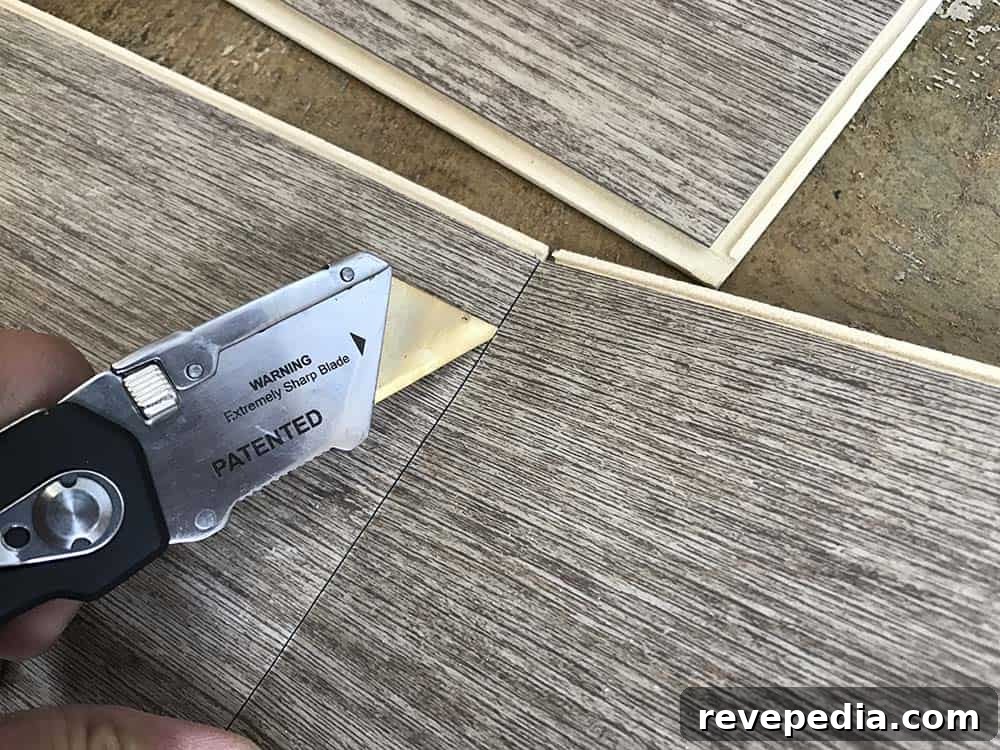
The easiest way to cut the planks is to score both sides with a utility knife and snap them. A miter saw can be used for cleanup if needed, but scoring and snapping is usually sufficient and creates less mess.
As you progress, ensure each row stays square. If a row goes off-square, you’ll need to correct it immediately—otherwise the problem will compound. The planks are designed to snap together easily without force.
Once we found our rhythm the installation moved quickly. We had to take extra care around a small corner and near the window sill, but Floorte bends and snaps into place without much fuss. We ordered a few extra planks to allow for mistakes or cuts, which is always a good idea.
Final Touches
When the flooring was complete we swept the room. There was no glue, no large tool mess, and no sanding dust—just a finished floor that was ready to use immediately. Our next and final post in this series will cover how Floorte performs over time.
Here’s a short video we recorded during the DIY install process.
This post is a sponsored conversation written by me on behalf of Shaw Floors. The opinions and content are my own.