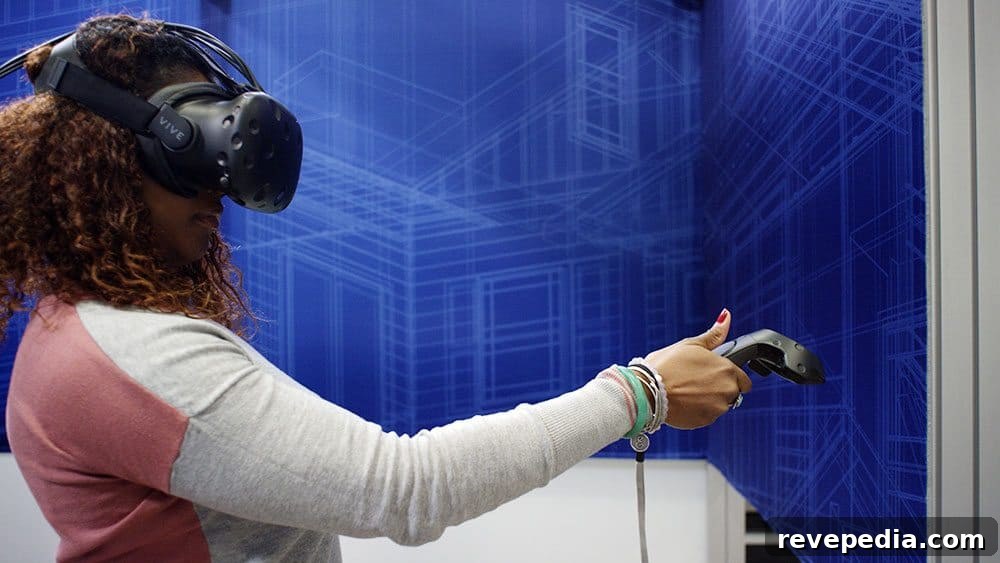
Major home improvement retailers are evolving to meet changing consumer habits: improving mobile apps, expanding stylish product lines, and investing in e-commerce. Lowe’s, however, is exploring a new frontier by heavily investing in augmented and virtual reality tutorials through its Holoroom How-To experience.
Currently available in a limited number of stores on the U.S. East Coast, Holoroom How-To uses an HTC Vive headset to guide users step-by-step through a do-it-yourself project. The pilot experience focuses on tiling a shower, demonstrating the full process from preparation to finishing. If the program gains traction, Lowe’s plans to expand the library with additional home improvement projects.
This approach addresses a key challenge for retailers: younger consumers are finding new ways to access information and increasingly rely on on-demand labor services such as Handy and TaskRabbit, which can reduce DIY activity. By leveraging immersive VR instruction, Lowe’s aims to engage a generation of prospective DIYers who want hands-on learning without the intimidation often associated with home projects.
The Holoroom offers more than just a visual walkthrough. Immersive tutorials can simulate tools, materials, and common mistakes, allowing users to practice skills in a risk-free environment before attempting the real work. For homeowners and renters who lack confidence or experience, this kind of guided practice can lower barriers to DIY and help build lasting skills.
From a retail perspective, Holoroom How-To can also strengthen the connection between education and sales. When shoppers learn a technique in-store, they are better equipped to select the correct tools and supplies, increasing the likelihood they will purchase materials directly from Lowe’s. That closes the loop between learning and shopping while positioning the retailer as a trusted resource for both products and practical knowledge.
There are broader implications for how technology can reshape home improvement education. Immersive experiences make complex processes more accessible, encourage repetition until skills are mastered, and can be updated to reflect new techniques or products. As AR and VR hardware becomes more common and affordable, these training tools could migrate from in-store demos to online and at-home experiences, further expanding reach.
Lowe’s pilot reflects a strategic bet that interactive, experience-driven retail can coexist with digital convenience. While e-commerce and sleek product design remain essential, offering hands-on learning opportunities creates a differentiated value proposition. If successful, Holoroom How-To could help rekindle interest in DIY projects among younger consumers and convert that interest into long-term customer loyalty.
For now, the Holoroom remains limited in scope and geography, but its potential is clear: immersive tutorials can demystify home improvement tasks, boost customer confidence, and tie education directly to sales. As Lowe’s expands the program and measures its impact, this initiative could serve as a model for other retailers aiming to blend technology, instruction, and commerce into a seamless customer experience.