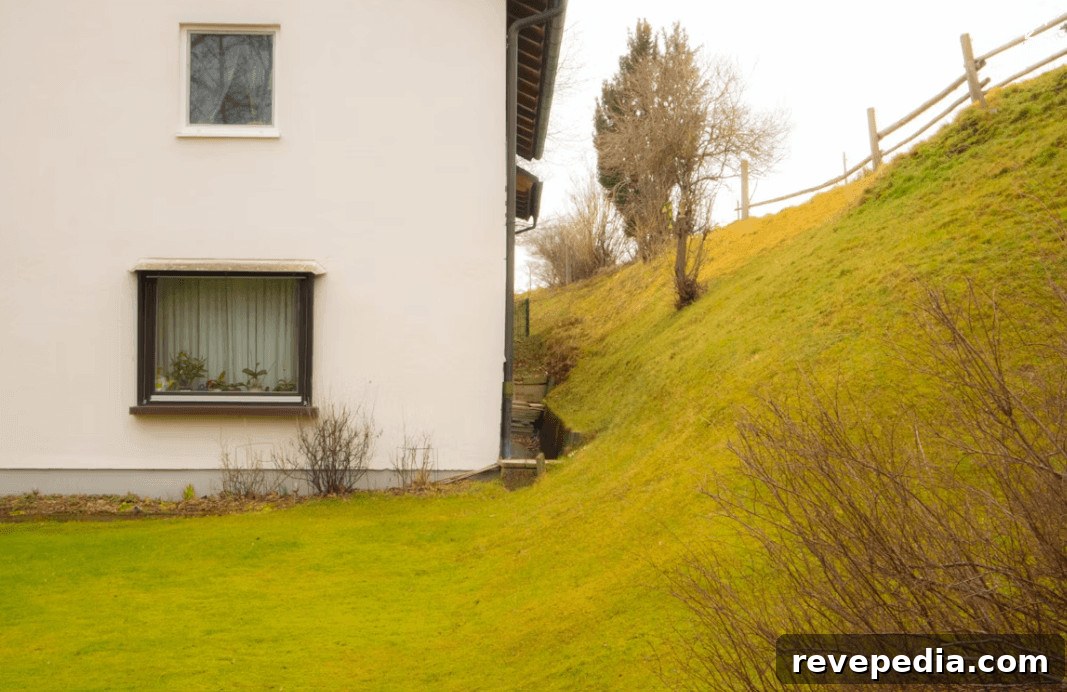
Every spring someone discovers that a large portion of their slope has migrated onto the patio. Mulch drifts away, bare spots expand, and a trench forms where water prefers to run — getting deeper with each storm.
Most homeowners respond by spreading more mulch and tossing down more seed, then repeating the same cycle the following year. Professional crews stopped using that approach long ago because on a construction site washed-out soil means failed inspections, stop-work orders, and real costs. Their solutions are simple, practical, and rarely require anything more than tools you can rent for an afternoon.

Below are five effective methods professionals use that any homeowner can adopt.
1. Treat holding soil and catching soil as two separate problems.
Before any product matters, professionals make a distinction many homeowners overlook.
Keeping soil in place is one job. Catching the soil that escapes is a different one. Construction crews addressing erosion and sediment control build both systems simultaneously because relying on only one leaves a clear vulnerability.
Consider a typical backyard slope. Laying straw or mulch across it helps protect the surface from raindrop impact and slows erosion, but it doesn’t prevent soil already mobilized from reaching a driveway. A strip of edging at the bottom might trap runoff but does nothing to stabilize the slope itself.
Use both approaches: protect the slope surface, then install a trap at the low point to capture any sediment that still moves. That shift in thinking prevents far more erosion than buying yet another bag of seed.
2. Slow the water down instead of speeding it away.
The homeowner instinct is to move water off the property quickly by digging channels or adding drains. Professionals do the opposite, and the science explains why: water’s ability to carry soil increases strongly with its speed. Fast water strips soil; slow water drops it and soaks in.
Practical ways to reduce flow velocity on a slope:
- Install check dams across flow paths. On sites these are rock piles or fiber rolls set perpendicular to the slope. At home, short sections of coir log pinned across the grade perform the same role inexpensively.
- Break long runs into shorter stages. Dividing a long, uninterrupted slope into multiple smaller steps dramatically reduces erosive force.
- Give water places to pause. A shallow planted depression or rain garden holds runoff long enough for it to infiltrate rather than rush downhill.
- Divert clean water around the problem. Roof runoff crossing a bare slope causes avoidable damage; a modest berm or re-routed downspout sends that clean water elsewhere.
Many backyard erosion problems come down to a downspout aimed at the wrong spot. Redirecting it generally costs very little and prevents a lot of damage.
3. Spray your seed instead of scattering it.
Broadcasting seed on a slope often fails: seeds roll downhill, birds take their share, and the first rain moves most of what remains. Commercial crews use hydroseeding: a slurry that mixes seed, fertilizer, a light mulch, and a tackifier and is sprayed on the slope. The mixture adheres where it lands, retains moisture to speed germination, and resists the first storms while roots establish.
For steeper or more exposed slopes, hydromulching uses a heavier mulch and stronger binders to form a protective mat over the soil. Slopes steeper than about a 3:1 grade typically benefit from this upgrade.
You don’t need to own specialized equipment. Many landscape contractors will hydroseed a residential slope, and the cost often comes in lower than repeatedly reseeding areas that keep washing away. Ask for a quote before spending more on broadcast seed for a slope that has already rejected previous attempts.
4. Put a barrier at the bottom and maintain it.
Silt fence shows up on construction sites everywhere, yet homeowners rarely use the same idea. That’s a missed opportunity because the concept scales easily for yards.
The goal is simple: intercept sediment-laden water at the low edge, hold it long enough for particles to settle, and allow cleaner water to pass. In a yard this can be a temporary fabric barrier during work, a dense permanent planting strip, or a gravel trench along the base of a slope.
Installation matters. Fabric barriers need their bottom edge buried; otherwise water will flow under them and render them decorative. Stakes should be on the downhill side so runoff presses the fabric against the supports rather than pulling it away.
Maintenance is crucial. A barrier loaded with trapped sediment is ineffective, so clear accumulated material periodically. Crews inspect their controls after significant rain events; adopting the same habit at home preserves the barrier’s capacity and effectiveness.
5. Never leave ground bare, even temporarily.
Site supervisors consistently cite the same exposure: open soil left exposed through a wet period. Homeowners create that scenario frequently when projects stall and bare earth sits through weeks of rain. Soil present in spring can be gone by summer.
Professionals limit this risk by phasing work to expose only what they will finish soon and by applying temporary cover to any area that will remain idle. Straw, wood chips, or an erosion control blanket can protect exposed soil for months at low cost.
Apply these practices at home:
- Strip only the portion you can finish in the next few weekends.
- Cover exposed areas if work pauses for more than a couple of weeks.
- Establish permanent plantings before the wettest part of the year, not after.
- Keep a roll of erosion blanket on hand — waiting until a storm to buy one is too late.
This is particularly important during demolition or major landscape changes, when large swaths of soil can be disturbed at once. Planning how much area will be opened and how quickly you can cover it determines the risk.
Small Effort, Big Payoff
None of these strategies require high-tech equipment or large budgets. They reflect what happens when soil loss becomes a financial problem instead of a nuisance and crews design simple systems to prevent it.
Start by observing your yard during the next real downpour. Note where water enters the property, where it gathers speed, and where it exits. That five-minute observation will tell you more about your erosion issue than guessing, and it will indicate which of these five practical methods your slope needs.