Let’s say you want to use two different types of flooring in adjacent rooms, but the space has an open-plan layout and the transition will be highly visible. Should you abandon the idea or use the same flooring everywhere? Absolutely not — the key is designing the transition thoughtfully.
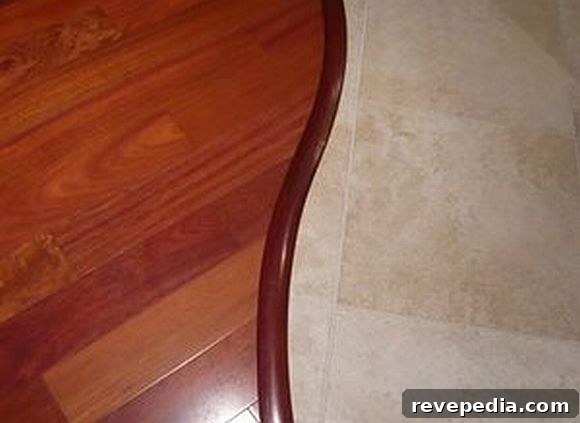
We were impressed by designer Paul Anater’s creative solution to a similar challenge. In a renovation he tackled a 45-degree junction between Brazilian cherry hardwood and tile. The easy, conventional approach would have been to lay a straight 45-degree cherry threshold between the two floors.
Paul dislikes 45-degree angles in architectural details, so he developed a more refined approach. Before installation, he sketched an “S” curve to guide the transition. Though the flooring installer was skeptical at first, he ultimately embraced the concept. A gently curved strip of solid cherry was fabricated and installed, producing a striking and elegant transition in a highly visible area of the home.
The takeaway: when you face a similar transition, choose a solution that feels intentional and confident. Think of it like an unexpected fashion choice that looks bold at first, but once worn with conviction it becomes stylish. A well-designed transition that reads as a deliberate element of the room will feel natural and attract admiration rather than criticism.
If you’ve encountered a difficult flooring junction in your own home, consider drawing or mocking up a curved transition before committing to materials. Test the visual flow at full scale and make sure the curve complements the room’s lines and traffic patterns. A custom wood strip or threshold can be milled to follow the curve precisely, and careful installation will ensure a seamless fit between materials.
Practical tips to consider:
- Mock up the transition with paper or thin plywood to visualize how the curve sits in the room.
- Choose a wood species and finish that harmonize with both adjoining floors so the transition reads as an intentional connector.
- Work with an installer experienced in curved work; precise shaping and a tight joint are essential.
- Consider traffic flow and cleaning — gentle curves can be easier to maintain than sharp angled thresholds that trap dirt.
- Keep scale in mind: small, subtle curves often read as elegant, while overly large or complex shapes can feel fussy.
Ultimately, thoughtful design turns a potential problem into a distinctive feature. A carefully planned curve or custom threshold can elevate the whole space, making the junction feel like a purposeful, artful part of the home rather than an afterthought.
Photo courtesy of Paul Anater