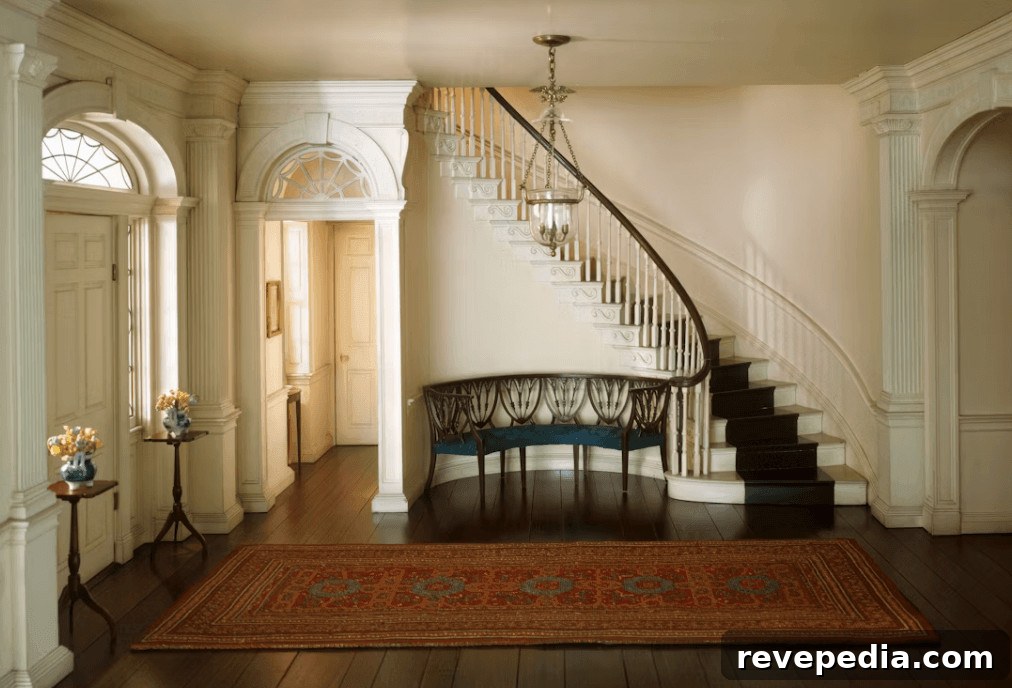
An entry vestibule—the small enclosed space between an exterior door and the main interior of a home—is often treated as an architectural or decorative detail. In practice, it performs a clear, measurable function: it reduces energy loss each time someone enters or exits the house. Understanding how this works clarifies why a vestibule can be valuable for more than just curb appeal.
The Basic Problem a Vestibule Solves
When an exterior door opens directly into a home’s main living area, conditioned indoor air and unconditioned outdoor air meet without obstruction. In winter, warm indoor air can escape and cold outdoor air can rush in during the few seconds the door is open; in summer, the opposite happens when air conditioning is running. Each opening and closing creates a brief exchange of air. Repeated throughout a day — and especially at a heavily used main entrance — those small exchanges add up to a significant amount of lost heating or cooling energy, often more than homeowners expect.

Photo by: Art Institute of Chicago
How a Vestibule Interrupts That Exchange
A vestibule works by introducing a small buffer zone with two doors instead of one: an exterior door and an interior door with an enclosed space between them. A typical sequence looks like this: the exterior door opens, the person steps into the vestibule and closes that door, and only then does the person open the interior door to enter the home. At no point during normal use are both doors open at the same time, so outdoor air never has a direct, continuous path into the main conditioned space. That separation is fundamentally different from a single-door entry, where every opening momentarily connects indoor and outdoor air.
Why This Matters for High-Traffic Entries
The energy-saving effect of a vestibule becomes more meaningful the more often the door is used. A seldom-used side or basement door will provide relatively little energy benefit because it simply doesn’t open enough for cumulative losses to be large. By contrast, a primary entrance that families use dozens of times per day benefits substantially: those many small interruptions to direct airflow reduce total heating and cooling loss in a way that can be measured and felt over time.
Comfort Benefits Beyond Energy Savings
Besides measurable energy savings, vestibules improve comfort by reducing drafts and sudden temperature swings in the room immediately beyond the entry. Many people notice a blast of cold air traveling into a living room each time a front door opens during winter; a vestibule lessens or eliminates that effect. This immediate increase in comfort is often the most noticeable everyday benefit, even if the homeowner is not focused on energy metrics.
Design Details That Determine Effectiveness
Not all vestibules deliver the same level of benefit. Several design details influence how well the buffer actually performs:
- Sealing: Each door must seal effectively. Poor weatherstripping or gaps on either door significantly reduces the benefit, because air will bypass the buffer through leaks.
- Size: The vestibule should be large enough to allow comfortable entry and exit without feeling cramped, but it shouldn’t be so big that it becomes a separate, substantial unheated or uncooled volume that needs its own energy considerations.
- Interior door placement and use: The interior door must be positioned and used so it remains closed as intended. A habitually propped-open interior door defeats the buffer’s purpose entirely.
Deciding If a Vestibule Makes Sense for Your Home
A vestibule usually makes the most sense when placed at a home’s primary, most frequently used entrance, especially in climates with meaningful heating needs in winter or cooling needs in summer. For secondary entrances that see little traffic, the construction cost and architectural changes may not justify the modest energy savings those doors would provide.
Designing to Deliver Actual Benefits
If you are thinking about adding or renovating a vestibule, discuss practical details such as door placement, sealing and weatherstripping, and appropriate sizing with your designer or contractor. Those specifics determine whether the finished vestibule will actually deliver the intended energy and comfort benefits or simply serve as a decorative foyer that looks attractive but performs poorly.
Header photo by: Art Institute of Chicago