
My wife’s grandmother left us a wool Persian rug, and I made a costly mistake: I rented a steam cleaner and went to town on a Saturday. By Sunday the reds had bled into the cream border. That error cost us about four hundred dollars and a month waiting on a specialty shop. I’m sharing this so you can avoid the same fate.
You can safely clean many oriental rugs at home year-round if you stick to surface care: vacuuming, beating, and careful spot treatment. Deep cleaning a hand-knotted or antique rug is a different task and belongs to a professional who can test and read fibers and dyes before using water. Understanding that distinction takes only a few minutes and can save you thousands. Plenty of homeowners skip straight to a machine and learn the hard way.
The core issue is that rugs have layers of soil you don’t see. Dry dust and grit work down into the base of the pile, and every footstep grinds those particles against the fibers like sandpaper. If you want a truly cleaner rug, real cleaning starts with removing that dry soil before any liquid touches the fibers. Water plus grit equals felted wool, and felted wool cannot be restored.
Everything below explains how to apply that principle safely and effectively.

Identify the rug you’re standing on
Not every rug follows the same rules. A mass-produced rug from a big-box store behaves very differently from a hand-knotted Kerman or an heirloom Persian. Before buying cleaning products or applying water, spend a few minutes identifying the type.
- Hand-knotted wool or silk. Investment-grade pieces. Treat them like furniture, not flooring.
- Machine-made wool or viscose. Generally tougher, but viscose looks like silk and can behave like wet paper when it gets wet.
- Flat-weaves and kilims. No pile, so dust has nowhere to hide. The weave is often looser and more prone to distortion.
- Natural fibers (jute, sisal, seagrass). Do not soak these; moisture encourages rot and lasting odors.
Flip a corner and look at the back. Hand-knotted rugs show individual knots and a slightly irregular line at the edge. Machine-made rugs show a regular grid and a uniform backing. That quick check tells you whether you’re dealing with a replaceable floor covering or a valuable piece worth professional care.
My strong recommendation: if a rug costs more than a decent laptop, don’t wet-clean it yourself. Surface maintenance is fine; full immersion is best left to pros. The risk-to-reward math usually favors restraint.
Weekly routine for oriental rug care
The single best thing you can do for any rug is regular, simple care. Think of it like brushing your teeth: short, consistent sessions prevent big problems.
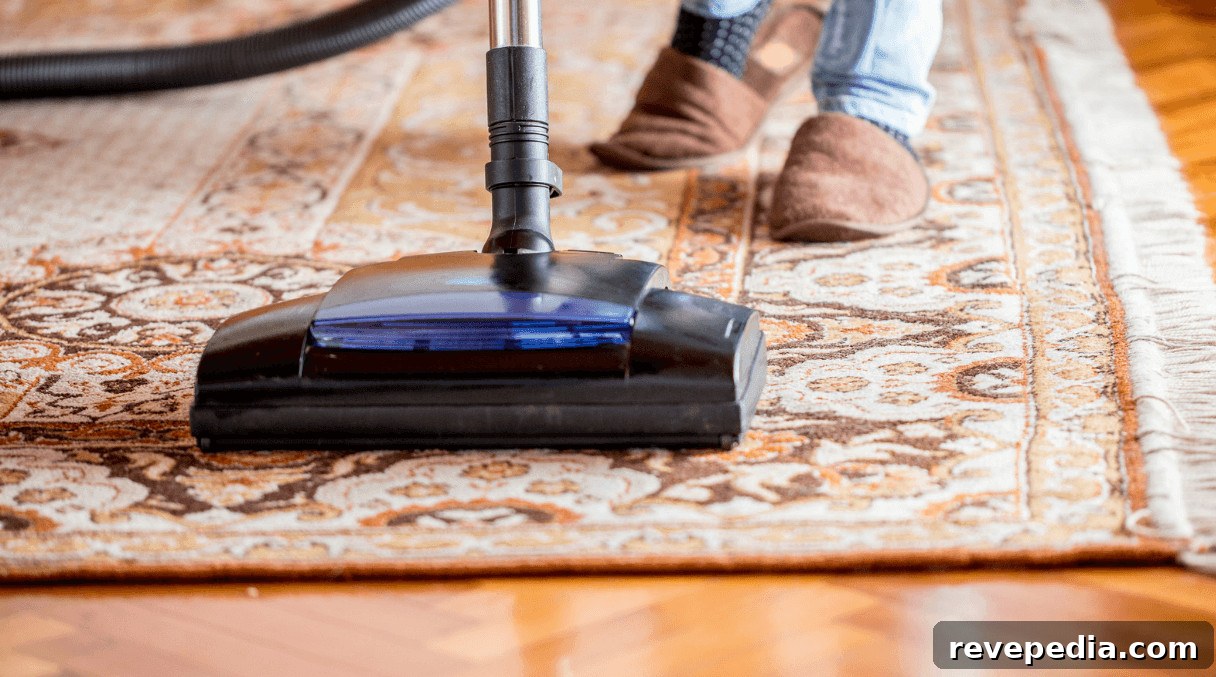
Vacuum with suction instead of an aggressive beater bar. If your vacuum has height settings, raise it so the brush barely contacts a wool rug and turn the brush roll off for antiques or anything with fringe. Make slow, overlapping passes in one direction, then go back across perpendicular to lift more embedded grit than quick straight swipes.
Every few weeks, take the rug outside on a dry day and lay it over a railing or clothesline to beat out dust with a broom handle or rug beater from the back side. The dust cloud will surprise you. This is the highest-value maintenance you can do without spending money, and most people skip it.
Rotate rugs twice a year. Sunlight and foot traffic wear and fade different areas unevenly; quarter turns help even the wear over the rug’s life.
Spot cleaning: a six-step triage
Spills are where good rugs often suffer permanent damage because people panic and scrub. Scrubbing pushes stains deeper and roughs up fibers. Follow this sequence and stop as soon as the stain lifts.
- Blot, don’t rub. Use clean white towels, press to absorb, lift, and repeat as towels load up.
- Lift solids first. Gently scrape with a spoon or dull knife, working from the edge of the spill inward.
- Test any solution in a hidden spot. A corner on the back is ideal. Wait ten minutes and check for color transfer onto a white cloth.
- Use the mildest solution that works. A drop of dish soap in a cup of cool water handles most food and beverage spills.
- Rinse with plain water and blot dry. Soap residue attracts dirt, so rinsing is mandatory.
- Weigh the area and allow airflow underneath. Place clean towels and a flat weight, prop the rug to let air move, and give it a full day to dry.
Avoid vinegar on wool and silk. Avoid bleach, oxygen boosters, or enzyme cleaners unless you’re certain of the fiber and dye stability. Never use hot water on an untested dye.
Fringe requires special care. Those loose ends are part of the rug’s foundation; soaking them can pull border dye onto the fringe. Vacuum fringe with the brush roll off and only use a suction attachment. If the fringe appears dirty, test one strand with a white cloth dampened in cool water and a drop of dish soap, dab, rinse with a clean damp cloth, and blot dry. If fringe is fraying or knots are loose, that rug needs professional attention.
Also note that volatile compounds from household cleaners can linger indoors for a long time. Rugs are porous and will hold onto whatever you apply. Ventilate the room while cleaning to reduce indoor air residues.
When to call a professional oriental rug cleaner
Some situations are best handled by a pro. Call a professional cleaner when any of these apply:
- The rug is antique, hand-knotted, silk, or has irreplaceable sentimental value.
- You’re dealing with pet urine, red wine, ink, or any stain that’s been sitting more than a day.
- A persistent odor seems to come from within the rug, not just the surface.
- Fringe is fraying or the rug’s foundation feels loose.
- You’ve already tried to clean it and the problem got worse.
Professional rug cleaners run dye fastness tests, perform dry soil extraction with commercial equipment, and use controlled washing and drying setups that prevent mildew and shrinkage. Manufacturer and textile-conservation guidance commonly recommends professional cleaning every two to four years for fine rugs, with more frequent service in high-traffic areas.
Textiles are damaged most by light, moisture, and improper handling—exactly the threats rugs face in everyday living rooms. Museums and historic collections use this same principle to preserve textiles, and the same precautions protect the rugs in your home.
The four-quadrant decision framework
Here’s a simple decision framework I use to determine whether to DIY or hire a pro.
| Rug value | Stain or wear level | Recommended action |
| Low (under $300) | Minor | DIY spot treatment without hesitation. |
| Low | Heavy, smells | Replace it—cleaning costs more than replacement. |
| High (heirloom, hand-knotted) | Minor | Stick to surface care only. Never wet-clean yourself. |
| High | Heavy or urgent | Call a professional immediately. Don’t wait a week. |
I’d rather spend a couple of hundred dollars on the right cleaning than replace a rug I love. In most cases, professionals are the safer choice for anything you’d describe proudly to a guest.
What good rug care actually looks like
Good oriental rug care comes down to a handful of steady habits: vacuum slowly, beat the rug outside twice a season, rotate it every six months, test liquids in a hidden corner, blot instead of scrub, and know when to call for professional help. With these small practices, a wool rug on a proper pad can endure decades of daily life. Skip them and you may lose something you can’t replace.
Which of your rugs is overdue for a vacuum right now?