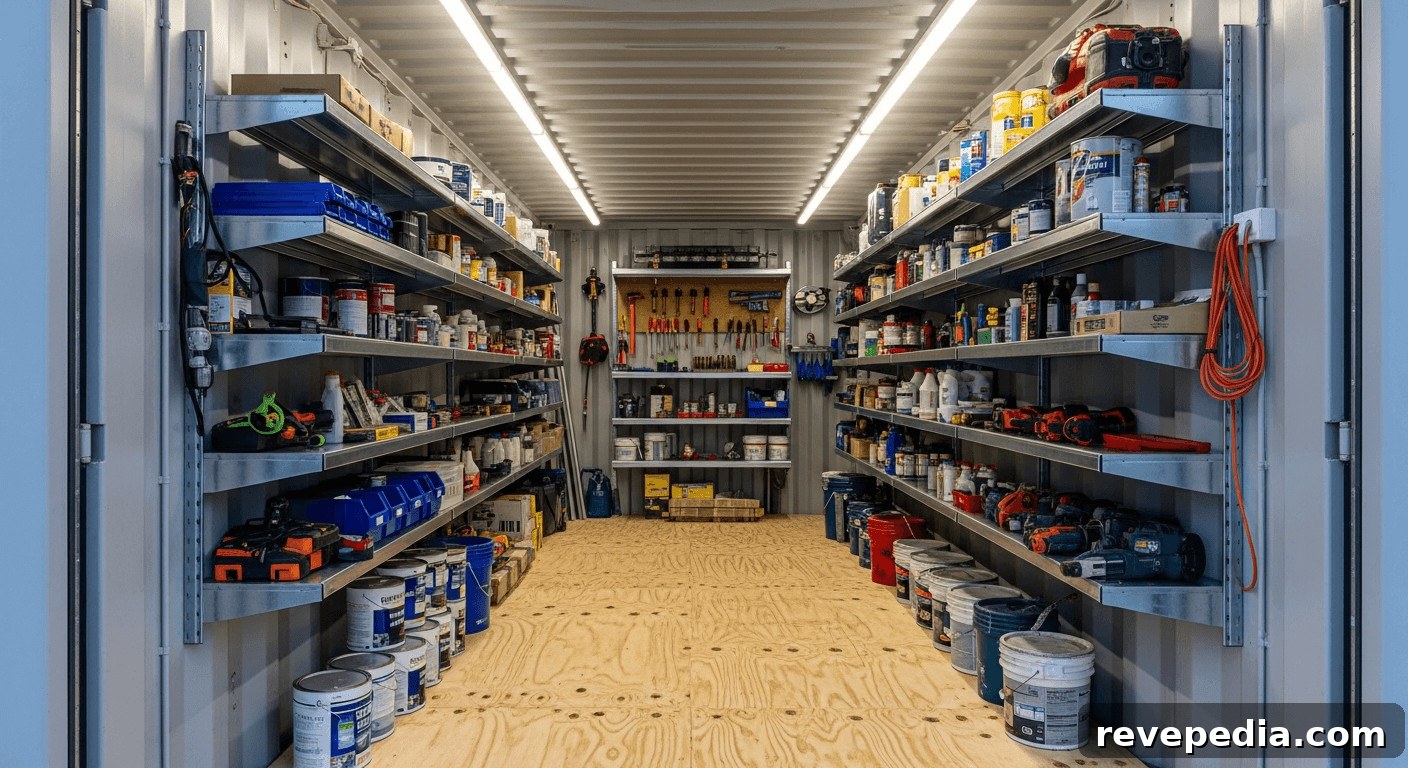
A shipping container is only as useful as the organisation inside it. Drop items in without a plan and within days you end up digging through a pile every time you need something. That may be acceptable for a single short-term job, but for businesses storing stock, tradespeople running a site store, or any operation where people enter the container daily, poor organisation quickly becomes inefficient and costly.
The good news is that shipping containers are well suited to organised storage. Their corrugated steel walls are strong enough for wall-mounted brackets and fittings, internal dimensions are consistent and easy to plan around, and there are no awkward in-room obstructions such as columns or boilers to break up usable floor space.
This guide covers practical, low-cost ways to make the most of container storage—whether you are storing tools on a construction site, managing business stock, or protecting materials during a build.
Start with a layout plan, not after delivery
One common mistake is to plan organisation only after the container arrives and starts getting filled. When storage is improvised you end up working around whatever is already in place, and changing it later is harder and more disruptive.
A simple floor plan is sufficient. Measure the internal floor area (a standard 20ft container is roughly 5.9m x 2.35m; a 10ft is around 2.85m x 2.2m) and sketch the walls. Before loading decide:
- Which items are needed daily versus occasionally?
- Can everything be stored on racking, or must some items remain on the floor?
- Do you need a dedicated workbench or only storage?
- Will multiple people be using the container at the same time?
Put frequent-access items nearest the door—ideally within the first third of the container. Reserve the back for occasional-use items. Keep heavy equipment low and stow lighter materials higher. Planning these zones on paper before the first pallet arrives saves time and avoids repetitive reorganising later.
Use vertical space properly
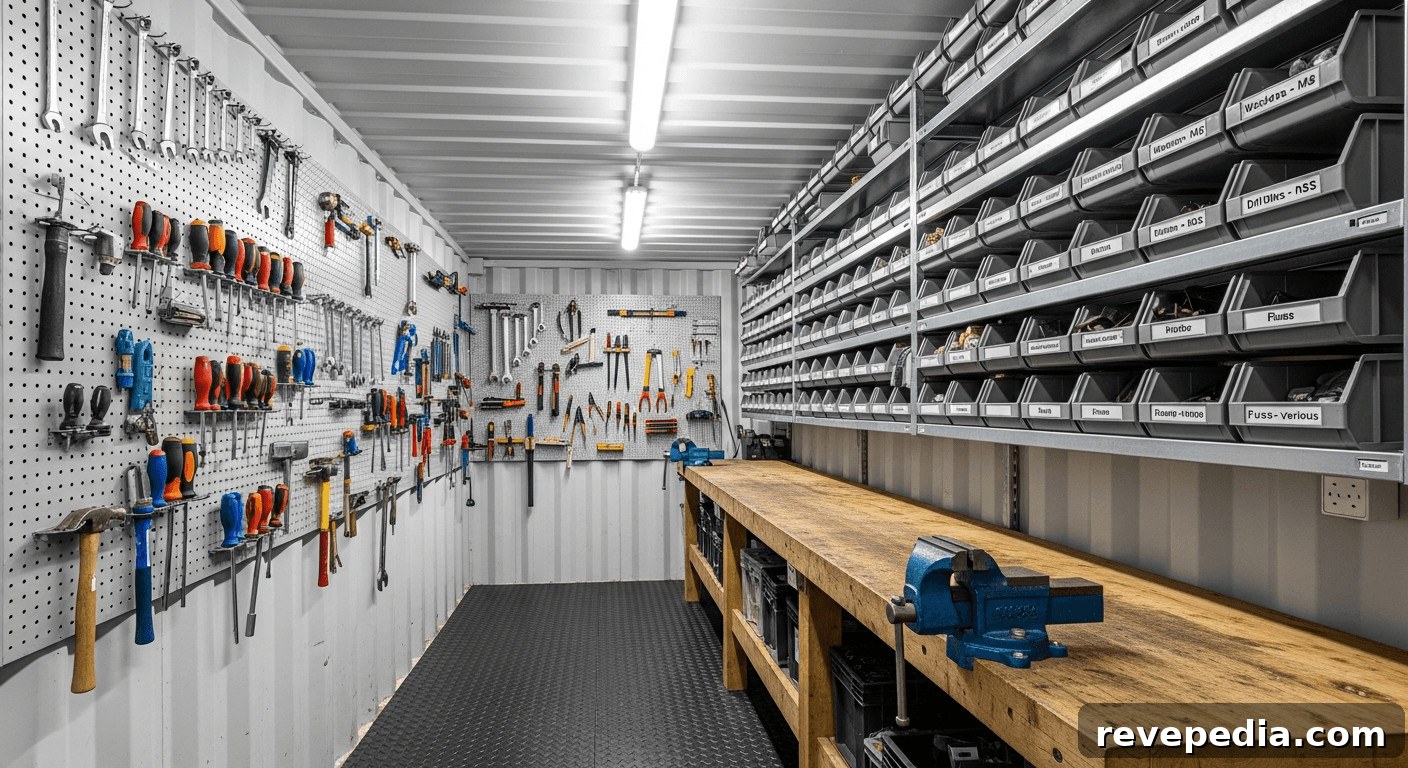
Floor area in a container is limited; vertical space is not. A standard container is about 8ft 6in internal height (a high-cube is around 9ft 6in), giving ample wall area that is often underused.
Racking brackets that bolt or weld to the corrugated walls are a practical solution. They lift stock off the floor, provide multiple tiers of accessible storage, and can be adjusted as needs change. Adjustable shelving is usually worth the slightly higher cost because it accommodates shifting stock sizes over time.
Suppliers of container-specific racking offer units designed to match the corrugated profile of shipping containers so shelving sits flush with the wall and doesn’t encroach on your working space.
For tools, fit a pegboard on the lower wall with hooks for immediate visual access. Magnetic strips are useful for smaller metal tools such as chisels and screwdrivers. Anything visible at a glance saves time on busy sites.
Group items by use, not only by size
Loading by size—large items at the back and small ones at the front—looks tidy but often mixes unrelated items and slows down picking. Instead, group by use or trade.
On a construction site this might mean dedicated runs of racking for electrical fixings and cabling, plumbing fittings and pipes, general fixings and screws, and a shelf for power tools and chargers near a power source. For retail or e-commerce stockrooms, group by product category or by picking frequency: best-selling lines at eye level near the door, slow-moving or seasonal stock further back or higher up.
Whatever system you adopt, it will only work if everyone understands and follows it. Tape a printed layout map inside the door showing where each bay or shelf holds inventory—this small step prevents confusion in shared spaces.
Label everything, including shelves
Labels feel unnecessary until they are missing. In single-user setups you might cope without them, but once more people access the container, unlabelled storage degrades rapidly.
Label both shelves and bins. If a bin of M8 bolts sits on a shelf labelled “M8 bolts,” it is straightforward to return the item to its proper place. Clear plastic bins with removable label holders outperform cardboard: they stack neatly, show contents, and withstand damp conditions better. For heavy items, use uniform stackable crates so reconfiguration is simple.
Sort out lighting before you need it
Containers are dark by default. A single bulkhead light near the door rarely illuminates the back of a 20ft container adequately. Working in poor light is frustrating and increases safety risks.
LED strip lighting along the ceiling or individual LED units above each racking section solve this effectively. Battery-powered or solar-charged units are available when running mains power is impractical. If the container doubles as a workspace, invest in proper overhead lighting rather than treating it as optional.
Keep the floor clear
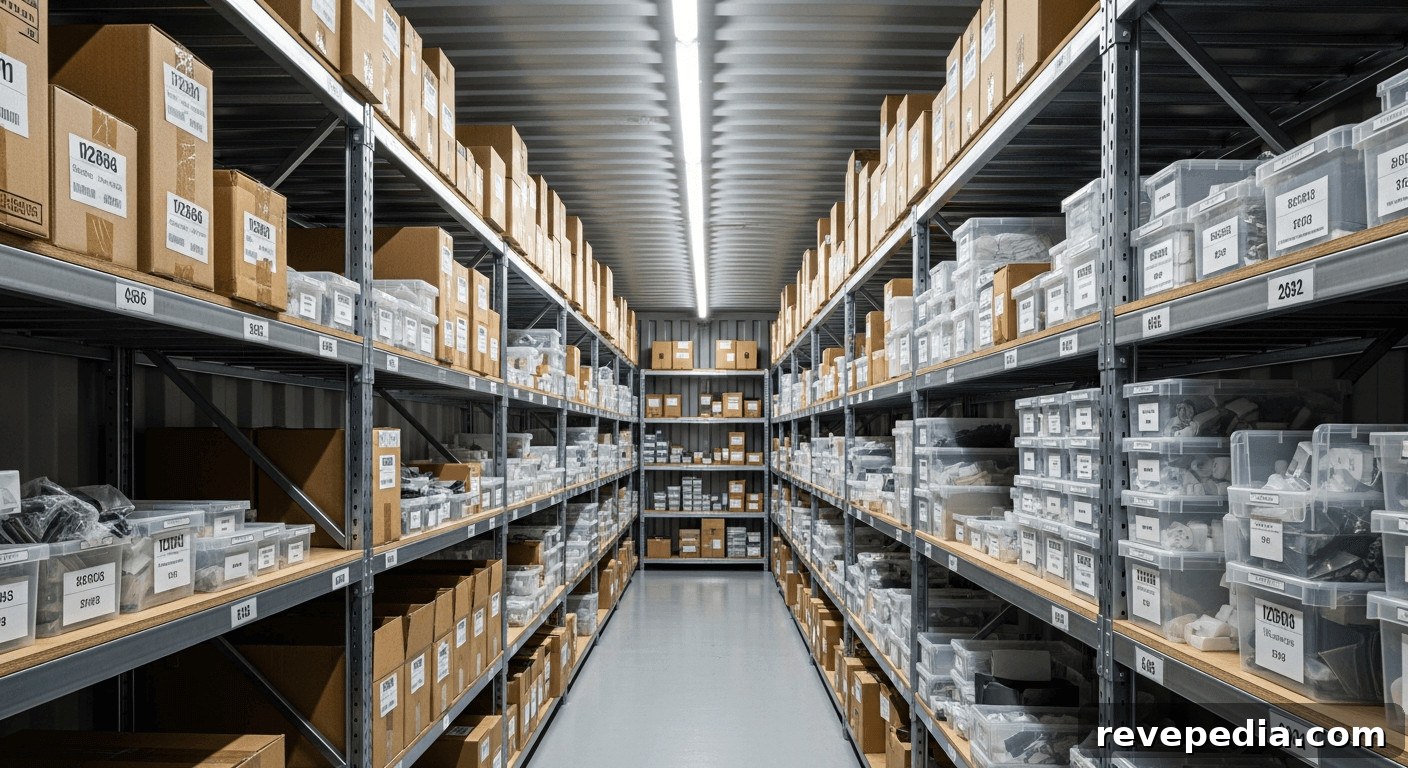
Using every inch of floor space is tempting, but a cluttered floor makes the container hard to work in. Blocked aisles hide lower shelving, slow movement, and increase trip hazards.
Keep the floor clear except for genuinely immovable items—large machinery, heavy cable reels, or bulk materials that cannot be shelved. Maintain a clear central aisle, even a narrow one; it improves safety and speeds up access during busy site operations.
Think about access before you store anything
Make high-frequency items the easiest to reach. Daily consumables—fixings, tapes, PPE, measuring tools—should be near the door at waist height. Weekly or monthly items can be stored further back and higher up.
If you store materials with limited shelf life—sealants, adhesives, paint—use a first-in, first-out approach so older stock is at the front. A small whiteboard on the inside of the door to list low-stock items is an inexpensive way to keep reordering on track.
Manage condensation before it causes damage
Condensation is a common and often underestimated risk in steel containers. Rapid temperature changes cause moisture to form on internal surfaces, which over time damages cardboard, corrodes unprotected metal tools, and harms humidity-sensitive products.
Ventilation and desiccants are the simplest remedies. Ensure factory vents are not blocked by racking or stock, and place silica gel absorbers on shelves where needed, replacing them when saturated. Keeping stock off the floor helps too, since the floor is usually colder and attracts moisture.
Where condensation is persistent, adding insulation board to walls and ceiling reduces temperature swings and moisture build-up—an involved modification, but one that improves year-round usability and protects stored items.
Security: plan layout as well as locks
Security starts with the door lock, but internal layout matters too. High-value items should not be immediately visible when the door opens. Placing valuable tools or stock toward the back reduces the likelihood of opportunistic theft.
For mixed-value storage, consider a lockable cage or cabinet inside the container to add a second layer of security. Some sites use a smaller lockable unit within the main container for the most valuable items. An internal hasp-and-staple arrangement with a padlock that can be secured from the inside provides a simple safety measure when someone is working alone inside the container.
The payoff is time saved
Good container organisation is practical, not decorative. It reduces the time spent finding items, lowers damage and loss, and creates a safer working environment. Most improvements require little investment: a clear layout, suitable racking, consistent labelling, and reliable lighting will deliver the biggest returns.
If you are setting up a container for the first time, fit racking and essential fittings before loading stock. Retro-fitting organisation into a full container is much harder than planning it from the start.